

Tachibana Muneshige was born the eldest son of Takahashi Shigetane, one of the principal retainers of the Ōtomo clan and commander of Iwaya Castle. In childhood, he bore the name Senkumamaru. His early years coincided with a period of intense military confrontation between the Ōtomo clan and other powerful warrior houses of Kyūshū—namely the Shimazu, Akizuki, and Ryūzōji clans.
Muneshige’s father, Shigetane, was renowned as a master of guerrilla warfare. He was particularly fond of employing feigned retreats, luring the enemy into a false sense of victory before launching counterattacks against their disordered formations.
The Takahashi and Tachibana clans jointly resisted attempts by neighboring powers to seize lands in Chikuzen Province. The heads of both clans were famous for their courage, decisiveness, and brilliant tactical thinking, and for many years they successfully repelled attacks from all three hostile clans.
Adoption into the Tachibana Clan
There exists a well-known but poorly substantiated story regarding Senkumamaru’s transition into the allied Tachibana clan. According to this tale, Takahashi Shigetane and Dōsetsu, head of the Tachibana clan, were once watching a theatrical performance together. The nature of the performance is unknown, but it suddenly devolved into a violent quarrel among the actors, during which one of them was killed. Panic broke out among the spectators, who rushed toward the exits.
The eight-year-old Senkumamaru, however, remained seated and calmly continued watching the altercation. Even when he was eventually swept up by the fleeing crowd, he laughed loudly at the panicking spectators. His composure and bravery impressed Dōsetsu, who proposed adopting Senkumamaru into the Tachibana clan, as he himself had no male heirs.
In the absence of a son, Dōsetsu had even begun preparing his daughter, Ginchiyo, to become head of the clan. This arrangement dissatisfied many of the Tachibana retainers, as not all were willing to accept a woman as clan leader. Dōsetsu therefore proposed a compromise: he would adopt Senkumamaru, who would marry Ginchiyo, and together they would rule the clan.
Shigetane resisted this proposal for many years, as Senkumamaru was meant to become his heir within the Takahashi clan. For this reason, contemporary chronicles often refer to him as Takahashi Munetora. Nevertheless, the adoption eventually took place, and he became known as Tachibana Muneshige.
First Military Campaigns
Muneshige is believed to have taken part in his first military campaign in 1581, fighting against the Akizuki clan under Dōsetsu’s command. Legend states that during one battle he shot an arrow into the arm of Akizuki retainer Horie Bizen. Though the wound was light, Bizen pulled out the arrow and charged the fourteen-year-old Muneshige with his sword. To Bizen’s astonishment, the youth was able to fight him on equal terms. They struggled for some time until a samurai of the Ōtomo clan came to Muneshige’s aid and killed Bizen.
In 1584, Ōtomo Sōrin ordered the Tachibana and Takahashi clans to retake lands in Chikugo Province that had been seized by the Akizuki. Muneshige fought under the Tachibana banner but alongside the warriors of his biological father. He was left in the rear with orders to guard Tachibana Castle on Mount Tachibana, while Dōsetsu and Shigetane marched out to meet the Akizuki forces.
When Akizuki Tanezane approached the castle and prepared to lay siege, Muneshige led a night sortie, attacking the enemy camp and setting it ablaze. Tanezane was forced to lift the siege and retreat.
Conflict Between Father and Son
After the armies returned, a victory banquet was held in Muneshige’s honor. During the feast, Muneshige referred to Shigetane as his father—biologically correct, but politically inappropriate, since his official father was now Dōsetsu. Shigetane openly corrected him, reminding him that Muneshige now belonged permanently to the Tachibana clan.
It appears that Shigetane still regretted the loss of his heir and only then fully realized what a gifted warrior he had lost. Only intense emotion can explain why he publicly reprimanded his son at a banquet held in his honor.
Death of Dōsetsu and Marriage to Ginchiyo
In 1585, Tachibana Dōsetsu died during a campaign against Neko Castle. His daughter Ginchiyo formally became head of the clan. Sources differ as to whether she and Muneshige had already been married since his adoption or whether the marriage occurred only after Dōsetsu’s death. Several explanations are offered for why Ginchiyo long refused to marry Muneshige: distrust of him as a member of the Takahashi clan, lack of respect for his achievements and abilities, or simple personal dislike.
There is also a legend claiming that Ginchiyo challenged Muneshige to a duel, promising to marry him if he won. The duel allegedly took place in the courtyard of Yanagawa Castle, where Muneshige lost and was sent to Tachibana Castle. However, this story is most likely a later fabrication.
In the end, the wedding did occur, but it was a purely political marriage. The spouses lived in separate castles and never had children.
Shimazu Invasion and the Death of Shigetane
The following year proved disastrous for the Ōtomo clan. Ōtomo Sōrin lost many of his generals in a series of failed campaigns. Ryūzōji Takanobu was killed in battles against the Shimazu, allowing Shimazu Yoshihisa to turn his attention toward Bungo Province. In May 1586, Sōrin left his residence in Usuki and traveled to Osaka to seek protection from Toyotomi Hideyoshi.
Meanwhile, the Shimazu invaded Takahashi territory and laid siege to Iwaya Castle. The attacking force, led by Shimazu Yoshihiro, is estimated by historians to have numbered between 20,000 and 50,000 warriors. Shigetane could oppose them with only a garrison of 700 men. The castle withstood the siege for 27 days and repelled several assaults, but ultimately fell. Shigetane was killed.
Siege of Tachibana Castle
With Iwaya fallen, Tachibana Castle lay next in the path of the Shimazu armies. The siege was led personally by Shimazu Yoshihisa. Muneshige did not remain passively behind the walls; his forces conducted near-daily surprise sorties, including nighttime raids, constantly harassing the besiegers. One report states that Muneshige personally led a raid and returned with several dozen enemy heads.
When news arrived of Hideyoshi’s massive army marching to aid the Ōtomo, Yoshihisa chose to withdraw. Muneshige, believing the Shimazu were preparing a final assault, launched a desperate attack against Yoshihisa’s forces. The Shimazu did not anticipate such an action, and Muneshige effectively won the engagement before retreating back into the castle.
Victory over the Shimazu and Rise to Power
Sources are unclear regarding what followed. Some claim that Muneshige pursued the retreating Shimazu and recaptured Iwaya Castle; others state that he withdrew to Yanagawa Castle while Tachibana Castle fell to the Shimazu. In any case, Muneshige soon joined Hideyoshi’s army and took part in the campaigns that defeated the Shimazu in 1587.
For his service, Muneshige was granted lands around Yanagawa Castle worth 100,000 koku of rice—or, according to some accounts, as much as 130,000. This was nearly one hundred times the income he had received from Tachibana Castle. He was also released from vassalage to the Ōtomo clan and thereafter ruled the independent Tachibana clan.
Korean Campaigns
In 1588, Muneshige assisted Sassa Narimasa in suppressing a rebellion in Higo Province. During this campaign, he formed a close friendship with Kobayakawa Hidekane. As a result, during the first invasion of Korea in 1592, Muneshige served under Hidekane’s adoptive father, Kobayakawa Takakage.
In Korea, Muneshige’s troops initially acted as a rear guard, securing roads in Muju County while Takakage advanced toward Seoul. However, Muneshige was unexpectedly attacked by a Chinese army while on the march and was forced to retreat.
Later, in 1593, Muneshige participated as part of the vanguard in the Battle of Byeokjegwan, where, with the timely arrival of Takakage’s reinforcements, the Chinese forces were defeated. Muneshige’s younger brother, who had succeeded their father as head of the Takahashi clan, also distinguished himself in this battle.
During the second Korean invasion of 1597–1598, Muneshige was primarily engaged in defending castles captured from the Koreans. His only active combat operation involved assisting the retreating army of Konishi Yukinaga. In doing so, Muneshige fought alongside warriors of the Shimazu clan—his former enemies.
Divorce and Sekigahara
After Hideyoshi’s death in 1598, Muneshige and Ginchiyo formally divorced. Ginchiyo became a Buddhist nun, where she continued practicing martial arts.
In the Sekigahara campaign of 1600, Muneshige joined the Western Coalition despite his dislike of Ishida Mitsunari, rejecting the generous offers made by Tokugawa Ieyasu. Leading a force of one thousand men, he participated in the siege of Ōtsu Castle. It is believed that Muneshige possessed siege artillery, which was used against the defenders. The castle fell on October 21—the same day Tokugawa Ieyasu won the Battle of Sekigahara.
Muneshige withdrew toward Osaka and intended to join its defenders, but Mōri Terumoto, the nominal commander of the Western Coalition and castellan of Osaka Castle, advised him to return and defend his home province.
Final Defense and Fall
According to legend, in the port of Osaka Muneshige encountered the remnants of the Shimazu army. Under Shimazu Yoshihiro, they were making their way back to Kyūshū while evading Tokugawa search parties. Muneshige’s advisors urged him to attack his former allies and avenge the death of his biological father, as no better opportunity would arise. Muneshige instead acted nobly: he refused to attack Yoshihiro in his moment of hardship and effectively joined forces with him on the journey home.
Soon after returning to Yanagawa Castle, Muneshige found himself facing a 40,000-strong allied army under Katō Kiyomasa, Nabeshima Naoshige, and Kuroda Kanbei. As always, besieging Muneshige’s castle proved difficult. Faithful to his guerrilla strategy, he conducted repeated successful sorties, inflicting serious losses on the besiegers. However, shortages of food and ammunition grew, and each clash resulted in irreplaceable losses. Several key commanders and many defenders were killed.
During the final ambush while retreating to the castle, Muneshige nearly lost his life as the enemy closed in. His escape was made possible by a small temple south of the castle, where Buddhist nuns emerged in armor and bearing weapons, covering his retreat. The female unit was led by Tachibana Ginchiyo. Muneshige was wounded and ultimately entered negotiations, where his former comrades from the Korean campaigns, Kiyomasa and Kanbei, persuaded him to surrender.
An interesting fact: Shimazu Yoshihiro sent a small relief force to aid Muneshige, but it arrived after the castle had already surrendered. The troops therefore did not engage and returned to their province.
Rōnin and Restoration
Muneshige was declared a rebel, stripped of his titles and lands, and reduced to a rōnin. Katō Kiyomasa and Maeda Toshinaga invited him into their service, but Muneshige refused. It is believed that Kiyomasa personally petitioned Ieyasu to pardon Muneshige and restore him as a daimyō. Three years later, Ieyasu granted Muneshige a small fief in northern Kyūshū, far from his ancestral lands.
During the Osaka campaigns of 1614–1615, Muneshige was forced to fight on the Tokugawa side against his former allies. He served under the second shogun, Tokugawa Hidetada, and fought against the forces of Mōri Katsunaga. Afterward, his lands near Yanagawa Castle and an income of 100,000 koku were restored.
Muneshige later served as one of the instructors responsible for training the third shogun, Tokugawa Iemitsu. His final campaign was the suppression of the Shimabara Rebellion in 1637.
Legacy and Armor
One of Tachibana Muneshige’s suits of armor is preserved in the Tachibana Museum, located on the site of the former Yanagawa Castle. Judging by this armor, Muneshige possessed an exceptional height for a Japanese man of his era—approximately 180 centimeters—and extraordinary physical strength. His Etchū zunari kabuto helmet weighs one and a half times more than typical helmets of this type, being made of thicker steel. The crest in the form of a circle is known as a wanuki wakidate.
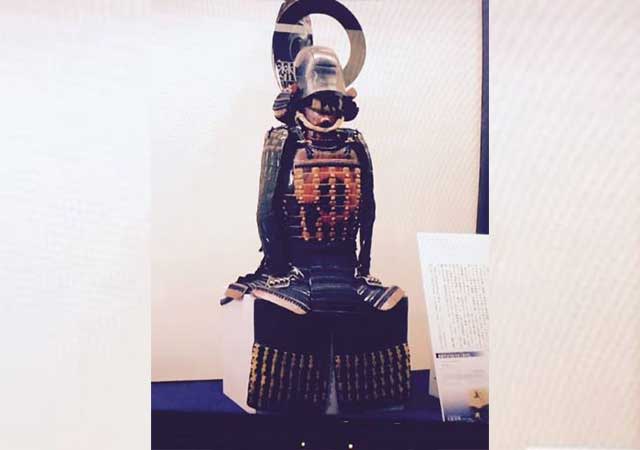
A similar motif appears on the cuirass and is referred to in Tachibana clan records as getsurin, meaning “moon circle.” This symbol was also used by other clans, where it was known as yanome, or “snake’s eye.” Katō Kiyomasa, for example, employed the same emblem. Many researchers interpret this shared design as a hint at the friendship between Kiyomasa and Muneshige.
The metal of the cuirass is likewise thicker than usual; the total weight of the cuirass and kusazuri skirt is about 12 kilograms. The armor was most likely bulletproof.
See also
-
Tokugawa Iemochi
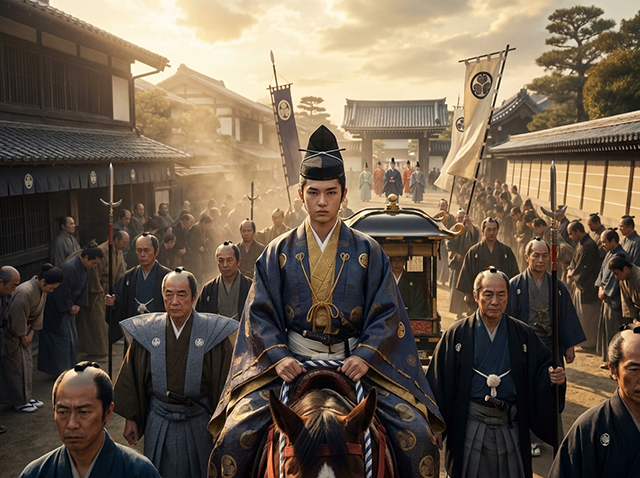
Tokugawa Iemochi (1846–1866) was the fourteenth shōgun of the Tokugawa shogunate and ruled from 1858 until his death. His reign came during the turbulent final years of the shogunate, when Japan faced growing Western pressure and serious internal political conflict.
-
Tokugawa Ienari
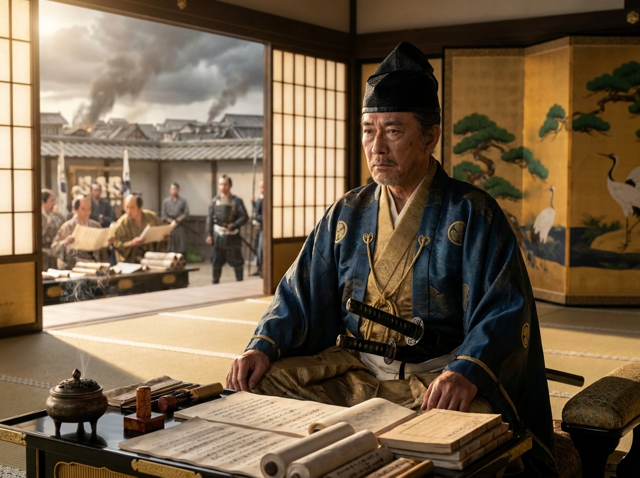
Tokugawa Ienari (1773–1841) was the eleventh shōgun of the Tokugawa shogunate and ruled from 1787 to 1837, making him the longest-serving Tokugawa shōgun. He was a great-grandson of the eighth shōgun, Tokugawa Yoshimune.
-
Matsudaira Nobuyasu
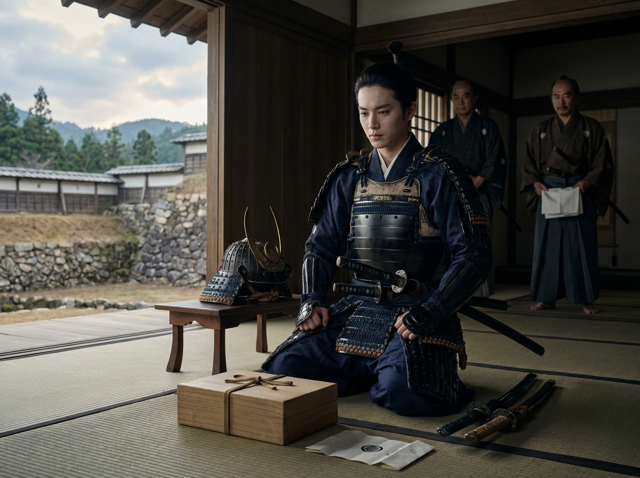
Matsudaira Nobuyasu was only twenty years old when his father ordered him to commit seppuku. The reason was not a defeat in battle, but a crisis inside the Tokugawa family that had become too dangerous to ignore.
-
Yamagata Masakage
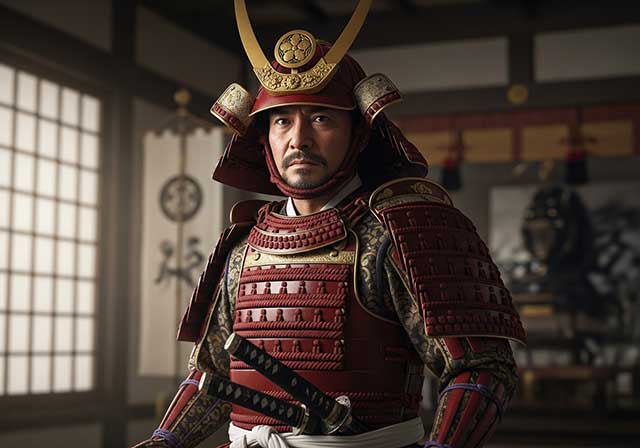
Masakage was one of Takeda Shingen’s most loyal and capable commanders. He was included in the famous list of the “Twenty-Four Generals of Takeda Shingen” and also belonged to the inner circle of four especially trusted warlords known as the Shitennō.
-
Yagyu Munenori
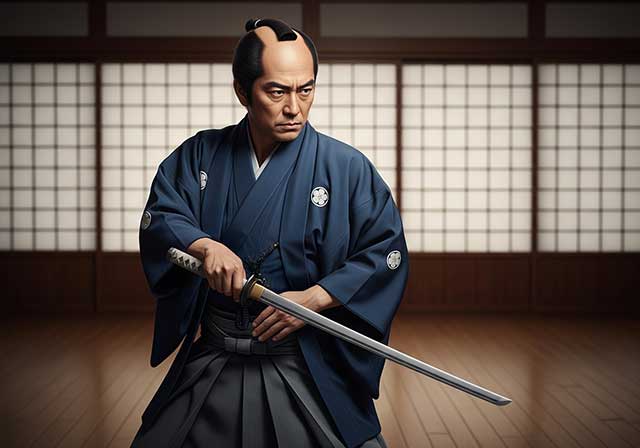
Yagyū Munenori began his service under Tokugawa Ieyasu while his father, Yagyū Muneyoshi, was still at his side. In 1600, Munenori took part in the decisive Battle of Sekigahara. As early as 1601, he was appointed a kenjutsu instructor to Tokugawa Hidetada, Ieyasu’s son, who later became the second shogun of the Tokugawa clan.
-
Yagyu Muneyoshi
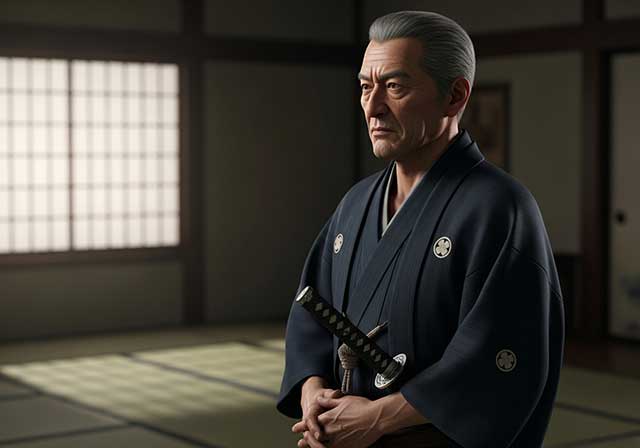
A samurai from Yamato Province, he was born into a family that had been defeated in its struggle against the Tsutsui clan. Muneyoshi first took part in battle at the age of sixteen. Due to circumstances beyond his control, he was forced to enter the service of the Tsutsui house and later served Miyoshi Tōkei. He subsequently came under the command of Matsunaga Hisahide and in time became a vassal first of Oda and later of Toyotomi.
-
Endo Naozune
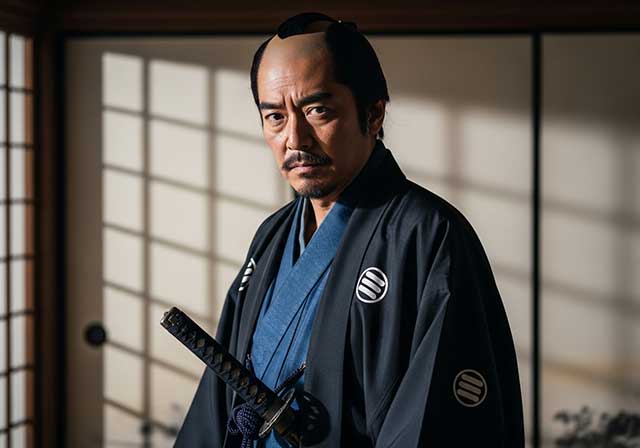
Naozune served under Azai Nagamasa and was one of the clan’s leading vassals, renowned for his bravery and determination. He accompanied Nagamasa during his first meeting with Oda Nobunaga and at that time asked for permission to kill Nobunaga, fearing him as an extremely dangerous man; however, Nagamasa did not grant this request.
-
Hosokawa Sumimoto
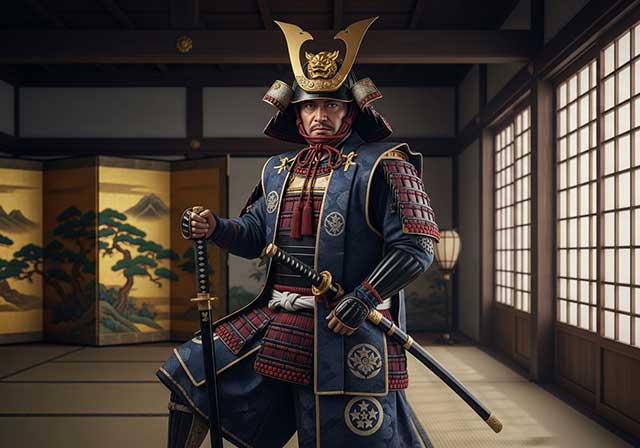
Sumimoto came from the Hosokawa clan: he was the biological son of Hosokawa Yoshiharu and at the same time the adopted son of Hosokawa Masamoto, the heir of Hosokawa Katsumoto, one of the principal instigators of the Ōnin War. Masamoto was homosexual, never married, and had no children of his own. At first he adopted Sumiyuki, a scion of the aristocratic Kujō family, but this choice provoked dissatisfaction and sharp criticism from the senior vassals of the Hosokawa house. As a result, Masamoto changed his decision and proclaimed Sumimoto as his heir, a representative of a collateral branch of the Hosokawa clan that had long been based in Awa Province on the island of Shikoku. Almost immediately after this, the boy became entangled in a complex and bitter web of political intrigue.