


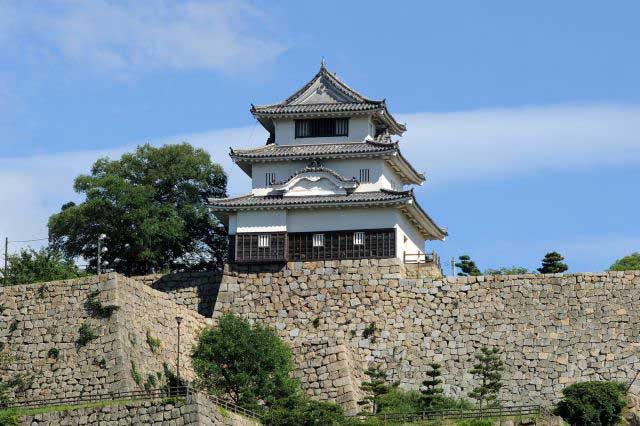
Marugame is part of the so-called “Authentic Dozen,” a group of twelve castles whose donjons have survived to the present day without major reconstructions since the Edo period.
After Toyotomi Hideyoshi’s forces conquered the island of Shikoku in 1587, Sanuki Province was granted to Ikoma Chikamasa (1526–1603). He initially settled in Hiketa Castle, but its location at the far eastern edge of the province made it difficult to govern all of Sanuki. For this reason, in 1590 Chikamasa built a new residence, Takamatsu Castle, located farther west along the coast.
In 1597, Marugame Castle was constructed on Mount Kameyama, a hill about 66 meters high, approximately 30 kilometers west of Takamatsu. After the construction was completed, Chikamasa moved there, appointing his son as the castellan of Takamatsu Castle.
During the Sekigahara Campaign in 1600, Chikamasa supported the Western Coalition, but at the same time he sent his son, Ikoma Kazumasa, to fight on the side of Tokugawa Ieyasu. As a result of the Eastern Coalition’s victory, the Ikoma clan retained its rights to Sanuki Province. During this period, Chikamasa once again moved to Takamatsu Castle. In 1615, in accordance with the Tokugawa shogunate’s decree of “one province, one castle,” Marugame Castle was abandoned. Today, only partially preserved stone walls on the eastern slope of the hill remain as reminders of this stage in the castle’s history.
In 1640, a conflict broke out within the Ikoma clan, prompting intervention by the Tokugawa shogunate, after which the Ikoma holdings were confiscated. The following year, these lands were granted to Yamazaki Ieharu (1594–1648), who was known as a capable administrator and castle builder. He received them in part as a reward for his achievements during the reconstruction of Osaka Castle and for his participation in suppressing the Shimabara Rebellion.
Although the Yamazaki clan was small and largely unknown, it was renowned for its talented fortification architects, who were considered on par with figures such as Kato Kiyomasa and Todo Takatora. Castles built by the Yamazaki, including Wakasa Oniga, Nariwa, and Tomioka, impressed contemporaries with the scale and strength of their stone structures.
After gaining control of Sanuki Province, the Yamazaki clan decided to construct a well-fortified castle on the site of the ruins of Marugame. Ieharu built some of the tallest stone walls in Japan at the time and also promoted the development of the castle town.
In 1657, the Yamazaki clan lost Sanuki Province because it was left without an heir. The remaining members of the clan were relocated to Nariwa Castle, which had previously belonged to them. The following year, the Kyogoku clan was transferred to Marugame from Tatsuno Castle. Earlier, this clan had served as governors of Wakasa Province with their seat at Obama Castle, and in 1634 they were moved to Matsue Castle. In 1637, the Kyogoku clan also found itself without an heir and was demoted, after which it was relocated to Tatsuno with a reduced income. After settling in Marugame, the Kyogoku clan undertook a large-scale reconstruction of the castle. The donjon that has survived to the present day was built in 1660. The complete reconstruction of the castle complex was finished by 1670, and in the same year the masugata gate complex of the Otemon, which still survives today, was constructed.
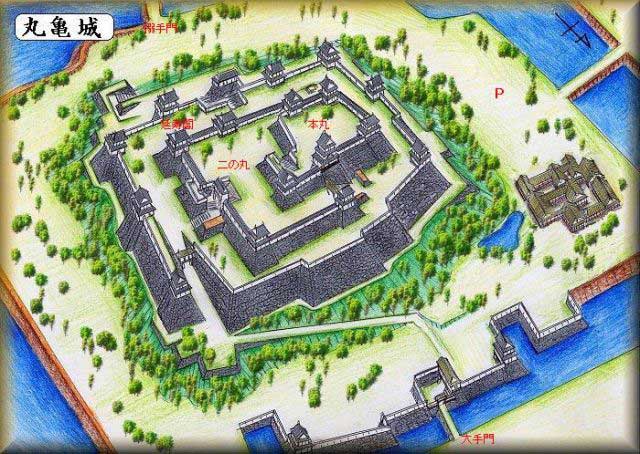
The castle is arranged on three levels. At the top of the hill were the main bailey, the honmaru, and the second bailey, the ninomaru. Below them lay the third bailey, the sannomaru, and farther down was the outer bailey, which was surrounded by water-filled moats. The total area of the castle grounds was approximately 500,000 square meters.
The upper half of the hill is completely reinforced with ishigaki stone walls, giving it the appearance of a stone pyramid. In some sections, the height of these walls exceeds 20 meters.
The tenshu donjon is located in the northern part of the main bailey and takes the form of a tower with three tiers and three floors. It belongs to the simplest dokuritsushiki type, as it has no additional attached structures.
The Kyogoku clan ruled the castle until the end of the Edo period. In 1869, a fire destroyed several towers. In 1871, in line with the policies of the new Meiji government, the castle was abandoned and transferred to the Japanese army. In 1877, many of the structures were dismantled, and only the donjon and the Ote Ichinomon and Ote Ninomom gates have survived to the present day. All three structures are designated as Important Cultural Properties.
In 1919, the upper part of the hill was purchased by the city of Marugame, and Kameyama Park was opened there. In 1943, the castle’s donjon was designated a “National Treasure” under the old Law for the Protection of National Treasures. In 1950, the donjon was dismantled, restored, and reassembled. In 2006, the Japan Castle Foundation (Nihon Jokaku Kyokai) included Marugame Castle on its list of the “100 Fine Castles of Japan.” The castle grounds are designated a National Historic Site. Marugame Castle is also known by the names Kameyama and Horai.
See also
-
Arato Castle
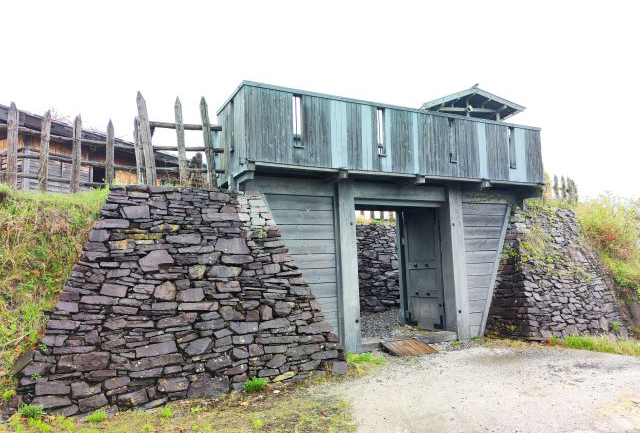
Arato Castle was built in 1524 by the Yamada clan under the orders of their overlord, Murakami, as a small mountain fort. Over time, it gained strategic importance and became a focal point in the conflict between two famous daimyō of the Sengoku period — Takeda Shingen and Murakami Yoshikiyo. This conflict turned the castle into one of the key fortifications in the struggle for control over Shinano Province.
-
Tatsuno Castle
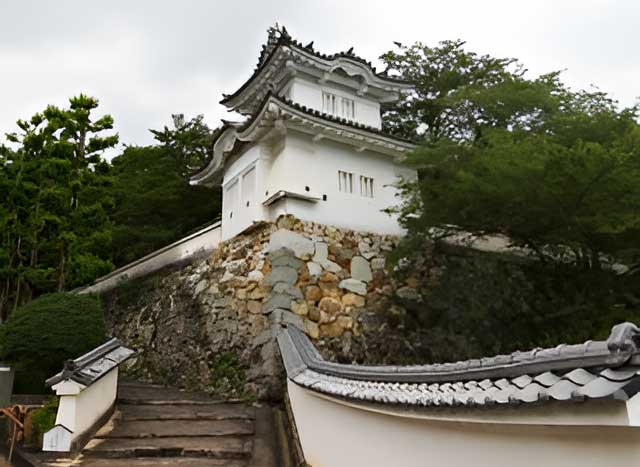
Tatsuno Castle is not a single fortification but rather a complex consisting of two parts: a mountain fortress located at the summit of Mount Keirozan and a flatland-mountain castle situated at its base. The mountain stronghold was built around 1499 by Akamatsu Murahide. During the Muromachi period, the Akamatsu clan was an influential family that, at the height of its power, controlled the provinces of Settsu, Harima, Bizen, and Mimasaka. Murahide’s ancestors were directly involved in the events of the Genkō War in the 14th century and in the subsequent establishment of the Ashikaga shogunate. However, by the 15th century, due to the process of gekokujō, the clan began to lose its position under pressure from rising families, including their former vassals—the Urakami and Bessho clans. In addition, the Akamatsu faced constant pressure from the Amago clan of Izumo Province.
-
Takamatsu Castle
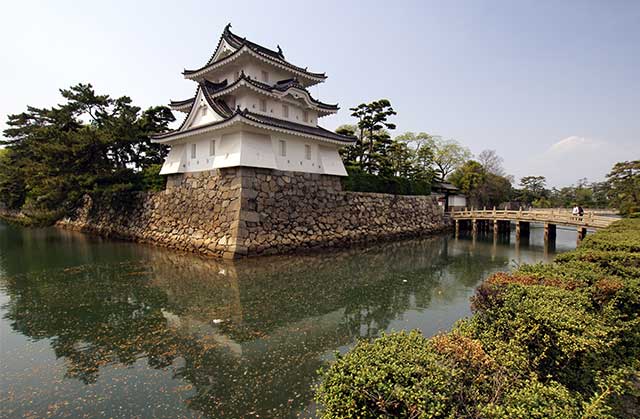
Takamatsu Castle was founded by Ikoma Chikamasa (1526–1603), who was appointed ruler of Takamatsu by Toyotomi Hideyoshi in 1587. The following year, Chikamasa began construction of the castle on the coast of the Inland Sea (Setonaikai), completing it by 1590.
-
Sawayama Castle
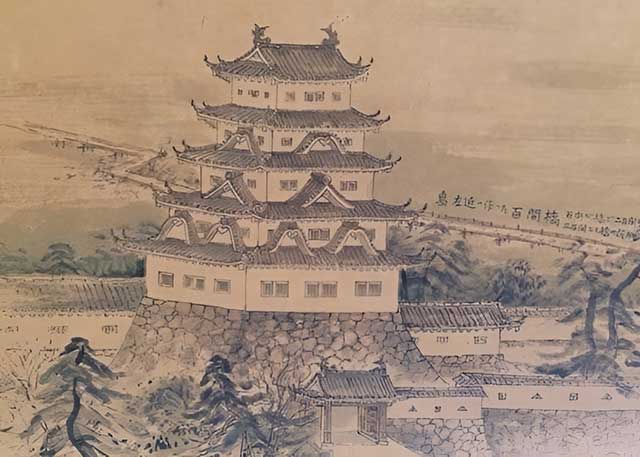
During the Kamakura period, Sabo Tokitsuna, the sixth son of Sasaki Sadatsuna, built a fort on Mount Sawayama. This fort occupied a strategically important position because it allowed control over traffic along the important Tōsandō route, which was later known as Nakasendō. This road connected the capital, Kyoto, with the eastern regions of the country. Due to its location, the fortification held great military importance, and during periods of civil war it repeatedly became the site of fierce battles.
-
Nadzima Castle
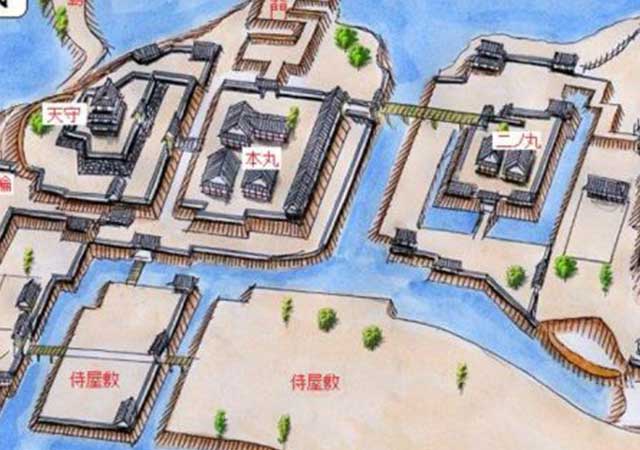
It is believed that the first structures on this site were built by Tachibana Akitoshi (?-1568), head of the Tachibana clan, a branch family of the Ōtomo clan, as auxiliary fortifications for Tachibanayama Castle. In 1587, Toyotomi Hideyoshi established control over the island of Kyushu and granted Chikuzen Province to Kobayakawa Takakage, one of the leading vassals of the Mori clan. Takakage began construction of a new castle on the site of the existing fortifications in 1588. The exact date of completion is unknown, but by the time the invasion of Korea began in 1592, the castle had already been finished, as records note that Toyotomi Hideyoshi stayed there overnight on his way to Hizen Nagoya Castle, which served as the headquarters of the invasion forces.
-
Kubota Castle
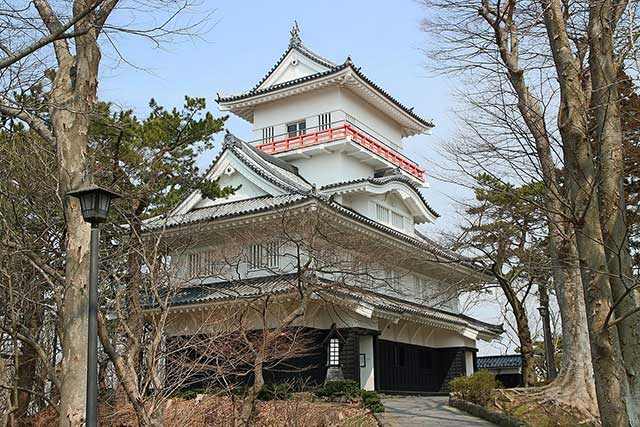
The founder of the castle is considered to be Satake Yoshinobu (1570–1633). Yoshinobu was one of the six great generals of Toyotomi Hideyoshi. During the Odawara Campaign of 1590, he took part in the siege of Oshi Castle under the command of Ishida Mitsunari, with whom Yoshinobu developed a good relationship.
-
Kavanhoe Castle
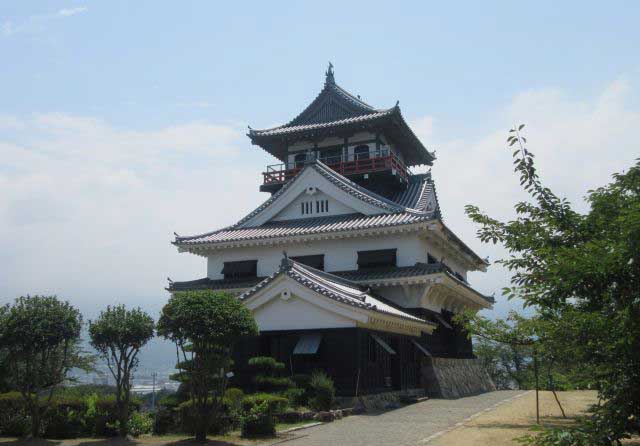
Kawanoe Castle is located on the small Wasi-yama hill near the port area of the Kawanoe district in the city of Shikokuchuo, occupying a central position along the northern coast of Shikoku Island. Kawanoe was also known as Butsuden Castle. The term “butsuden” in Japan refers to temple halls, and for this reason it is believed that a Buddhist temple once stood on the site before the castle was built. Due to its location at the junction of four provinces on Shikoku Island, Kawanoe held significant strategic importance and was repeatedly targeted by rival forces seeking military control over the region.
-
Yokote Castle
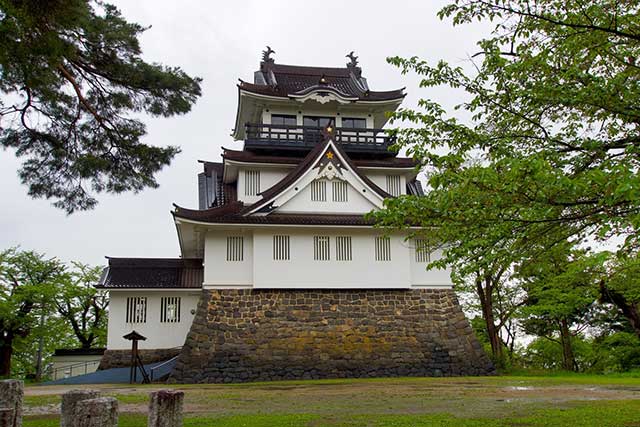
The founder of the castle is considered to be the Onodera clan. The Onodera were originally a minor clan from Shimotsuke Province and served Minamoto no Yoritomo (1147–1199), the founder of the first shogunate. The Onodera distinguished themselves in battle against the Fujiwara clan of the Ōshū branch and were rewarded with lands around Yokote. Around the 14th century, the Onodera moved to Yokote as their permanent residence. Their original stronghold was Numadate Castle, but after a series of clashes with the powerful Nambu clan, they relocated their base to the site of present-day Yokote Castle. It was likely during this time that the first fortifications appeared at the castle.