


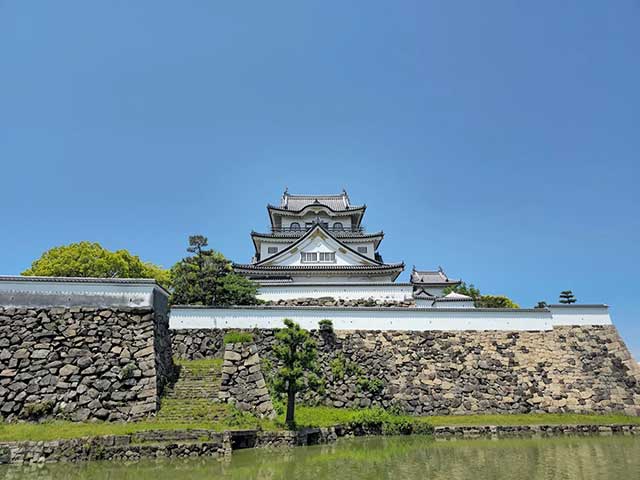
The celebrated 14th-century military commander Kusunoki Masashige (1294–1336), who owned extensive lands south of what is now the city of Osaka, ordered one of his vassals, Kishiwada Osamu, to build a fortified residence. This order was carried out around 1336. These fortifications became the first structures on the site of what would later become Kishiwada Castle. From the beginning, the castle stood in a strategically important location—roughly halfway between the cities of Wakayama and Osaka, south of the key port of Sakai. Because of this position, it changed hands several times during periods of warfare.
At the start of the Sengoku Jidai period, Kishiwada Castle was controlled by Miyoshi Yoshikata (1527–1562). Under his rule, the castle was greatly expanded and reinforced. In the second half of the 16th century, the castle became one of the battlegrounds in Oda Nobunaga’s struggle against the followers of the Ikko-ikki movement. Nobunaga seized the castle and appointed Oda Nobuharu as its commander, attempting to prevent the Ikko-ikki forces from the Saiga region and the Ishiyama Honganji temple from joining together. However, after Nobunaga’s death in 1582, his fears came true.
Two years later, Toyotomi Hideyoshi launched a campaign against Tokugawa Ieyasu, leaving the Osaka region without major military forces. The Saiga Ikko-ikki took advantage of this and attacked Kishiwada Castle. Their assault was stopped by Hideyoshi’s troops under the command of Matsuura Munekiyo and Nakamura Kazuuji in the Battle of Kishiwada. The castle itself withstood a two-month siege and later served as Hideyoshi’s base during the conquest of Kii Province.
To protect the port of Sakai and the approaches to Osaka, Hideyoshi appointed his uncle, Koide Hidemasa, as governor of Kishiwada and ordered him to build a new castle. Construction was completed in 1585: the castle gained stone walls, moats, and towers, and by 1597 it also had a powerful main keep.
During the Sekigahara Campaign, Hidemasa and his eldest son Yoshimasa fought for the Western Coalition, which ultimately lost. However, following the example of some other daimyo, Hidemasa sent his second son, Hideie, to fight for the Eastern Coalition. As a result, Kishiwada Castle remained in the hands of the Koide clan under the new Tokugawa shogunate.
In 1619, Koide Hideie was transferred to the Izushi Domain, and the castle was given to Matsudaira Yasushige. Yasushige added several buildings to the castle complex. In 1623, one of the towers was relocated from Fushimi Castle.
In 1640, Kishiwada passed to Okabe Nobukatsu. After that, the Okabe clan held the castle until the Meiji Restoration. The castle’s main keep burned down after being struck by lightning in 1827, and most of the remaining structures were destroyed during the Boshin Civil War.
In 1954, a new main keep (tenshu) made of reinforced concrete was built on the surviving tenshudai foundation. The original historic keep had five stories, while the current “reconstruction” has only three. The building was funded through donations, with a significant contribution from descendants of the Okabe family. The architect for the project was Ikedaya Hisayoshi. At first, the keep was used as a local library, and later it was repurposed into a history museum.
In 1969, the walls of the honmaru courtyard, along with some towers and gates, were reconstructed. Some of the castle’s stone walls and moats have survived since the time it was built. The museum collection is small, and the armor on display mostly dates to the Edo period. The castle grounds were also shaped in part by the well-known 20th-century landscape designer Mirei Shigemori. In 1953, he created the beautiful rock garden Hachi Jin-no Niwa within the castle. The stones for the garden were brought from Okinoshima Island, and the white sand came from the banks of the Shirakawa River near Kyoto.
The castle complex has national status as a scenic site. In 2017, Kishiwada was included in the list “Japan’s Continued Top 100 Castles” (Top 200). The castle is also known by the name Chikiro. In addition, several scenes from the 2021 film G.I. Joe: Snake Eyes were filmed at the castle.
See also
-
Arato Castle
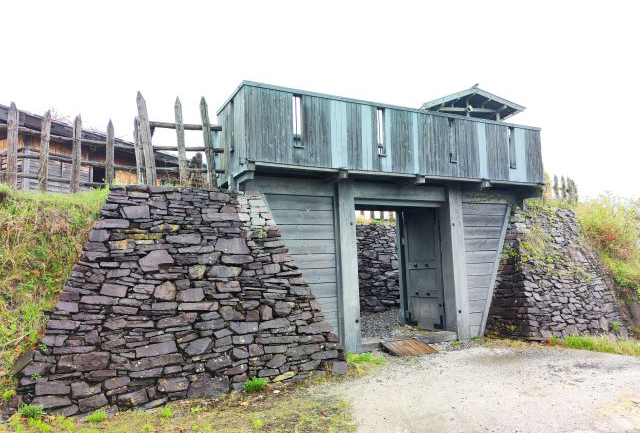
Arato Castle was built in 1524 by the Yamada clan under the orders of their overlord, Murakami, as a small mountain fort. Over time, it gained strategic importance and became a focal point in the conflict between two famous daimyō of the Sengoku period — Takeda Shingen and Murakami Yoshikiyo. This conflict turned the castle into one of the key fortifications in the struggle for control over Shinano Province.
-
Tatsuno Castle
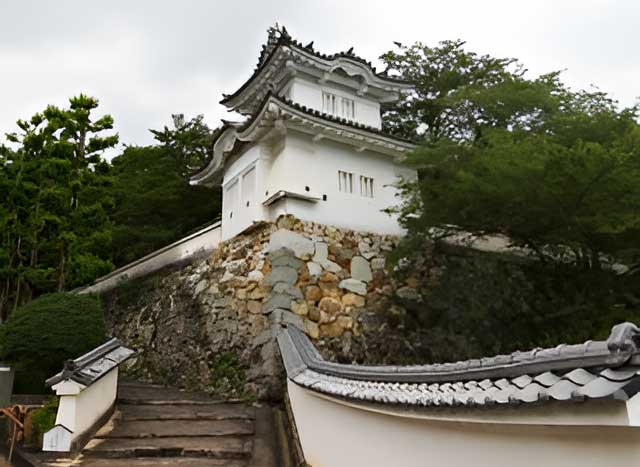
Tatsuno Castle is not a single fortification but rather a complex consisting of two parts: a mountain fortress located at the summit of Mount Keirozan and a flatland-mountain castle situated at its base. The mountain stronghold was built around 1499 by Akamatsu Murahide. During the Muromachi period, the Akamatsu clan was an influential family that, at the height of its power, controlled the provinces of Settsu, Harima, Bizen, and Mimasaka. Murahide’s ancestors were directly involved in the events of the Genkō War in the 14th century and in the subsequent establishment of the Ashikaga shogunate. However, by the 15th century, due to the process of gekokujō, the clan began to lose its position under pressure from rising families, including their former vassals—the Urakami and Bessho clans. In addition, the Akamatsu faced constant pressure from the Amago clan of Izumo Province.
-
Takamatsu Castle
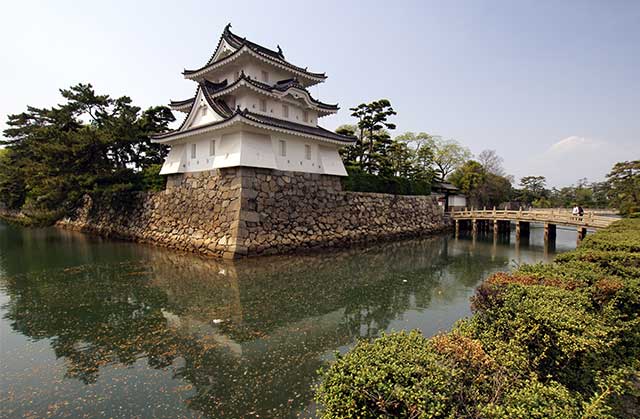
Takamatsu Castle was founded by Ikoma Chikamasa (1526–1603), who was appointed ruler of Takamatsu by Toyotomi Hideyoshi in 1587. The following year, Chikamasa began construction of the castle on the coast of the Inland Sea (Setonaikai), completing it by 1590.
-
Sawayama Castle
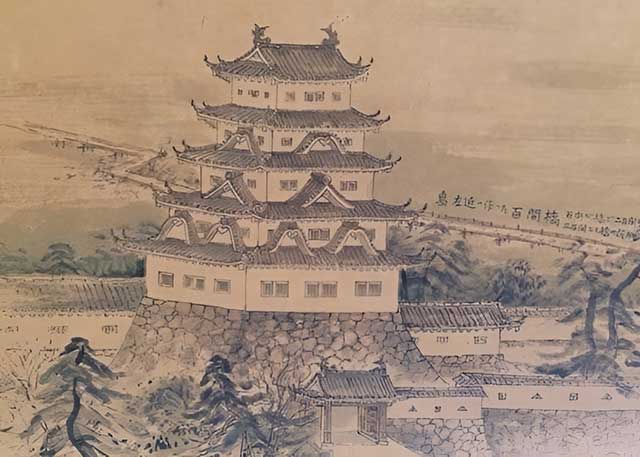
During the Kamakura period, Sabo Tokitsuna, the sixth son of Sasaki Sadatsuna, built a fort on Mount Sawayama. This fort occupied a strategically important position because it allowed control over traffic along the important Tōsandō route, which was later known as Nakasendō. This road connected the capital, Kyoto, with the eastern regions of the country. Due to its location, the fortification held great military importance, and during periods of civil war it repeatedly became the site of fierce battles.
-
Nadzima Castle
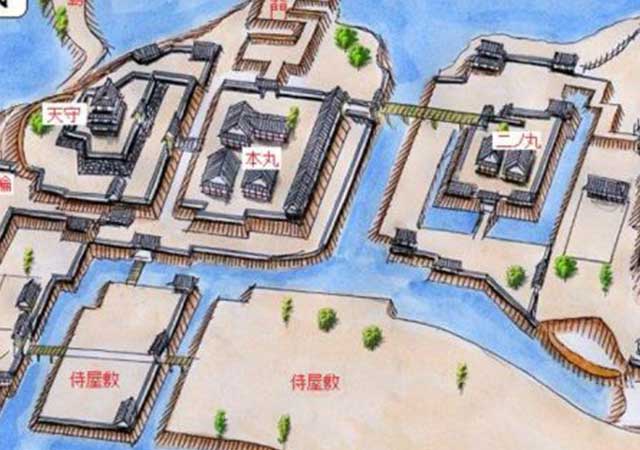
It is believed that the first structures on this site were built by Tachibana Akitoshi (?-1568), head of the Tachibana clan, a branch family of the Ōtomo clan, as auxiliary fortifications for Tachibanayama Castle. In 1587, Toyotomi Hideyoshi established control over the island of Kyushu and granted Chikuzen Province to Kobayakawa Takakage, one of the leading vassals of the Mori clan. Takakage began construction of a new castle on the site of the existing fortifications in 1588. The exact date of completion is unknown, but by the time the invasion of Korea began in 1592, the castle had already been finished, as records note that Toyotomi Hideyoshi stayed there overnight on his way to Hizen Nagoya Castle, which served as the headquarters of the invasion forces.
-
Kubota Castle
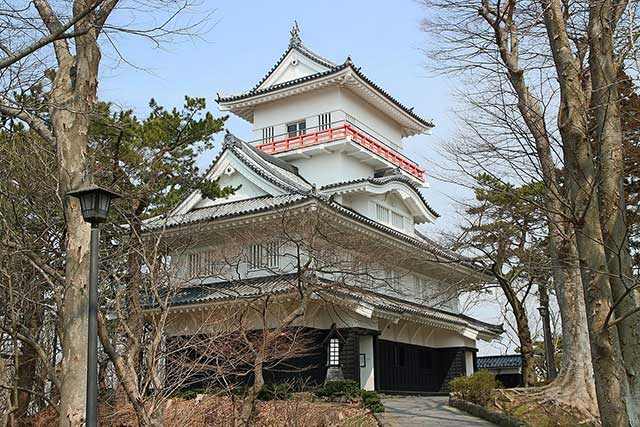
The founder of the castle is considered to be Satake Yoshinobu (1570–1633). Yoshinobu was one of the six great generals of Toyotomi Hideyoshi. During the Odawara Campaign of 1590, he took part in the siege of Oshi Castle under the command of Ishida Mitsunari, with whom Yoshinobu developed a good relationship.
-
Kavanhoe Castle
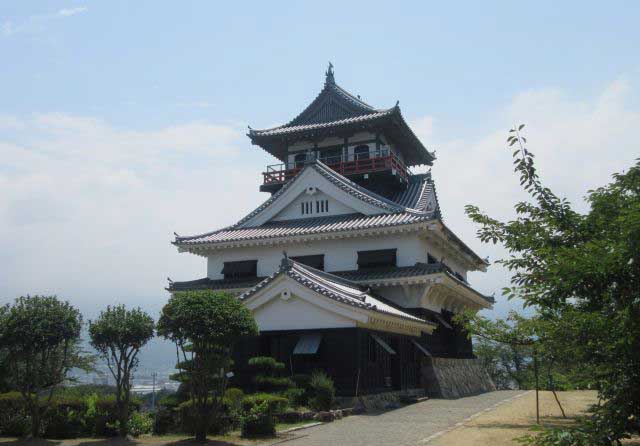
Kawanoe Castle is located on the small Wasi-yama hill near the port area of the Kawanoe district in the city of Shikokuchuo, occupying a central position along the northern coast of Shikoku Island. Kawanoe was also known as Butsuden Castle. The term “butsuden” in Japan refers to temple halls, and for this reason it is believed that a Buddhist temple once stood on the site before the castle was built. Due to its location at the junction of four provinces on Shikoku Island, Kawanoe held significant strategic importance and was repeatedly targeted by rival forces seeking military control over the region.
-
Yokote Castle
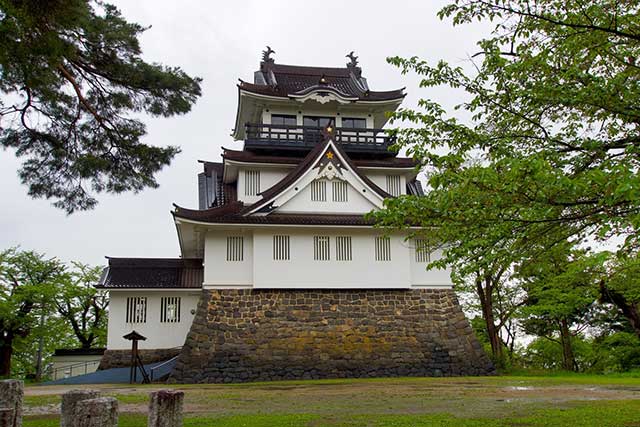
The founder of the castle is considered to be the Onodera clan. The Onodera were originally a minor clan from Shimotsuke Province and served Minamoto no Yoritomo (1147–1199), the founder of the first shogunate. The Onodera distinguished themselves in battle against the Fujiwara clan of the Ōshū branch and were rewarded with lands around Yokote. Around the 14th century, the Onodera moved to Yokote as their permanent residence. Their original stronghold was Numadate Castle, but after a series of clashes with the powerful Nambu clan, they relocated their base to the site of present-day Yokote Castle. It was likely during this time that the first fortifications appeared at the castle.