


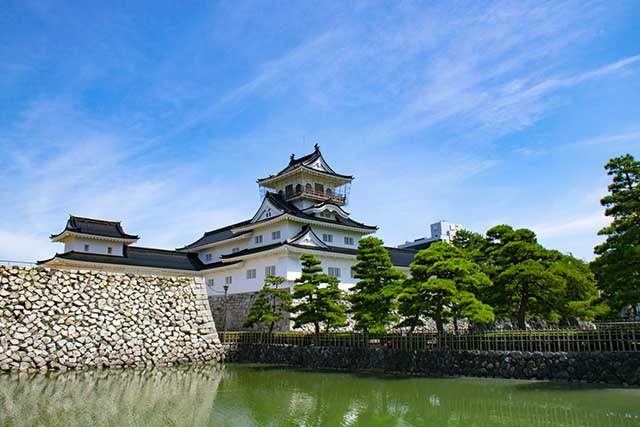
Toyama Castle is located almost in the very center of the former province of Etchū and is surrounded by a wide plain with a large number of rivers. The very first castle on the banks of the Jinzu River was built in 1543 by Jimbo Nagamoto. The Jimbo clan were vassals of the Hatakeyama clan and governed the western part of Etchū Province. The eastern part of the province belonged to their rivals, the Shiina clan, who were also Hatakeyama vassals. Beginning in the 15th century, the influence of the ancient Hatakeyama clan gradually weakened, and as a result, the Jimbo and the Shiina fought constant wars for control of the province. Meanwhile, the forces of the Ikkō-ikki movement periodically intervened, helping first one side and then the other.
In the 1550s, the Jimbo managed to defeat the Shiina, but the Shiina formed an alliance with the powerful daimyō Uesugi Kenshin. In 1560, Kenshin captured Toyama Castle after a fierce battle. Jimbo Nagamoto managed to escape, but two years later he submitted to the Uesugi clan.
Kenshin appointed Kojima Motoshige, a former vassal of the Jimbo clan, as commander of the castle. In 1569, Toyama was attacked by a combined force of the Ikkō-ikki and the Shiina clan.
After Uesugi Kenshin’s death in 1578, Oda Nobunaga took control of the region and appointed Jimbo Nagatsumi as the commander of Toyama Castle. However, as a result of a vassal uprising in 1581, the Jimbo once again lost control of the castle.
The castle passed to Sassa Narimasa. Sassa Narimasa (1539–1588) was a vassal of Oda Nobunaga. He fought alongside Nobunaga at the Battle of Anegawa (1570) and the Battle of Nagashino (1575), and he also helped suppress Ikkō-ikki uprisings. Narimasa was considered an expert in firearms tactics, and in battle he often commanded units of arquebusiers.
Narimasa greatly expanded and rebuilt the castle, adding new moats and towers. He also began flood-control projects, which transformed the area around the castle from marshland into fertile rice fields.
After Nobunaga’s death in 1582, Narimasa sided with Toyotomi Hideyoshi’s opponents. At the Battle of Shizugatake, Hideyoshi’s main enemies were defeated, and he was able to extend his influence over the Hokuriku region. Hideyoshi appointed his general Maeda Toshiie to govern Kaga Province. In response, Narimasa fortified the border with Kaga Province. He also launched a preemptive attack on Suemori Castle, but was driven back by Maeda’s forces.
In August 1585, Hideyoshi personally led an army of 100,000 men and invaded Etchū Province. Toyama Castle surrendered after a week-long siege. Hideyoshi then appointed Maeda Toshinaga (1562–1614), the son of Maeda Toshiie, as commander of Toyama.
In 1595, Toshinaga moved to Kanazawa Castle. During the Sekigahara campaign, Toshinaga sided with the Tokugawa, and as a result his rights to his lands were confirmed. He became the first daimyō of the new Kaga Domain, which included most of the former province of Etchū. The domain’s capital was the castle town of Kanazawa. Toshinaga decided to make Toyama his residence after retiring as head of the clan, and for that reason he significantly rebuilt Toyama Castle. The walls and moats were strengthened, and new buildings were added.
After Toshinaga’s retirement in 1605, his brother Maeda Toshitsune became the head of the clan and the domain. In 1639, Toshitsune divided the Kaga Domain among his three sons, creating the separate Toyama Domain. This domain went to Maeda Toshitsugu (1617–1674), but at first it did not include Toyama Castle itself. By 1659, Toshitsugu reached an agreement with the Kaga Domain, and through an exchange of territories he obtained Toyama Castle and the lands around it. In 1661, he received permission from the Tokugawa shogunate to reconstruct the castle, which had been badly damaged in the fire of 1609. However, no information has survived as to whether a new donjon was built. The descendants of Toshitsugu governed Toyama Castle until the Meiji Restoration of 1868.
The castle was partially destroyed during the earthquake of 1858, and the structures that survived were dismantled in 1871 by decree of the Meiji government.
In 1882, at the request of local activists, the castle ruins were officially designated by the authorities as “Toyama Park.” In 1885, the buildings of the Toyama Prefectural Government were constructed on the site of the former main enclosure, the Honmaru. After a fire in 1930, these buildings were rebuilt outside the castle ruins. From 1940 onward, the castle grounds once again became a public park.
In 1954, an Industrial Exhibition was held in Toyama Park, and to commemorate it a “Toyama Castle donjon” was built out of reinforced concrete.
This modern reconstruction is a fake donjon: its silhouette was clearly inspired by the surviving donjon of Hikone Castle. The architect was Yamamoto Katsumi, who had no prior experience in castle reconstruction. The building now houses a historical museum.
Most of the structures on the castle grounds were reconstructed around the same time. The only authentic structure in the present-day castle is the Chitose Gate, which was returned here in 2007. Previously it had been the gate of the Chitosegoten Palace (built in 1849), and after the castle was dismantled it “moved” into the possession of a wealthy farmer.
Some stone walls and moats from the historical castle have survived. The castle grounds also include the Sato Museum of Art and Tea Ceremony. It was opened in 1961 through the efforts of Sato Sukekuro, a businessman and tea master. Although the museum building resembles a fortification, it has no connection to the castle and is simply a stylistic imitation. Near the museum there is a small but picturesque traditional Japanese garden with a pond. In 2017, Toyama Castle was included in the list “Another 100 Remarkable Castles of Japan” (Top 200).
See also
-
Arato Castle
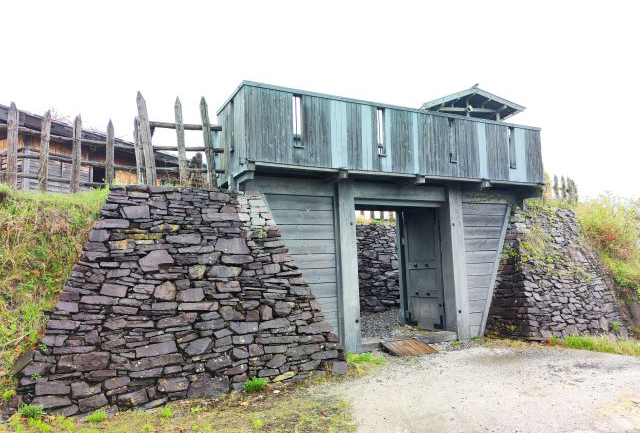
Arato Castle was built in 1524 by the Yamada clan under the orders of their overlord, Murakami, as a small mountain fort. Over time, it gained strategic importance and became a focal point in the conflict between two famous daimyō of the Sengoku period — Takeda Shingen and Murakami Yoshikiyo. This conflict turned the castle into one of the key fortifications in the struggle for control over Shinano Province.
-
Tatsuno Castle
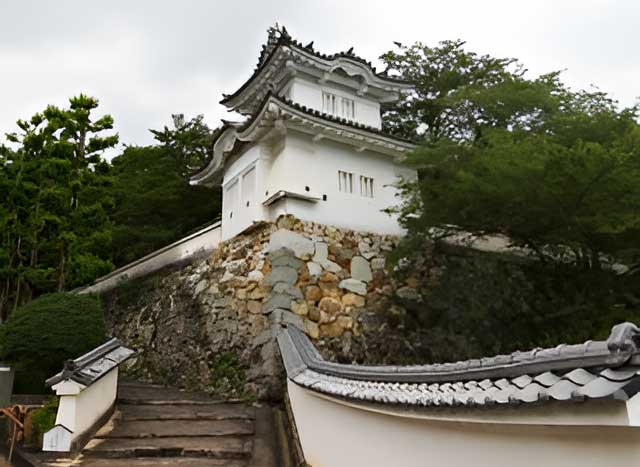
Tatsuno Castle is not a single fortification but rather a complex consisting of two parts: a mountain fortress located at the summit of Mount Keirozan and a flatland-mountain castle situated at its base. The mountain stronghold was built around 1499 by Akamatsu Murahide. During the Muromachi period, the Akamatsu clan was an influential family that, at the height of its power, controlled the provinces of Settsu, Harima, Bizen, and Mimasaka. Murahide’s ancestors were directly involved in the events of the Genkō War in the 14th century and in the subsequent establishment of the Ashikaga shogunate. However, by the 15th century, due to the process of gekokujō, the clan began to lose its position under pressure from rising families, including their former vassals—the Urakami and Bessho clans. In addition, the Akamatsu faced constant pressure from the Amago clan of Izumo Province.
-
Takamatsu Castle
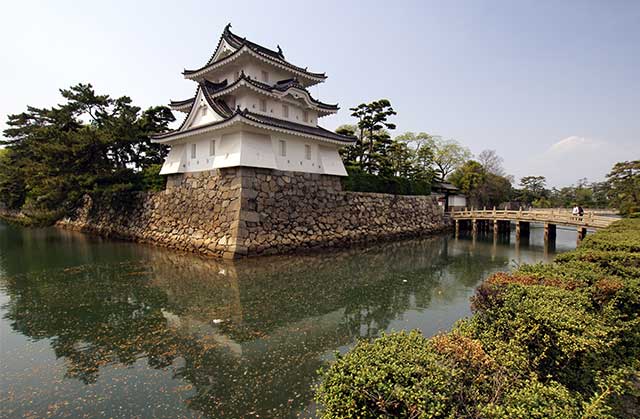
Takamatsu Castle was founded by Ikoma Chikamasa (1526–1603), who was appointed ruler of Takamatsu by Toyotomi Hideyoshi in 1587. The following year, Chikamasa began construction of the castle on the coast of the Inland Sea (Setonaikai), completing it by 1590.
-
Sawayama Castle
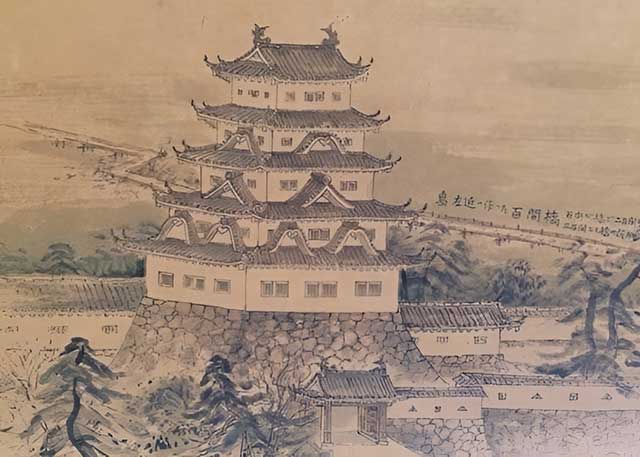
During the Kamakura period, Sabo Tokitsuna, the sixth son of Sasaki Sadatsuna, built a fort on Mount Sawayama. This fort occupied a strategically important position because it allowed control over traffic along the important Tōsandō route, which was later known as Nakasendō. This road connected the capital, Kyoto, with the eastern regions of the country. Due to its location, the fortification held great military importance, and during periods of civil war it repeatedly became the site of fierce battles.
-
Nadzima Castle
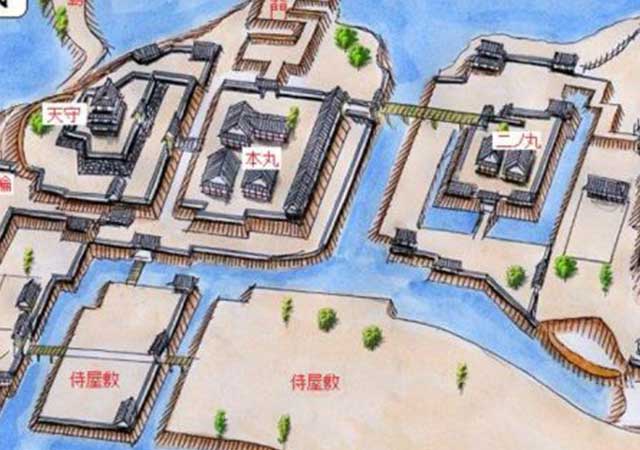
It is believed that the first structures on this site were built by Tachibana Akitoshi (?-1568), head of the Tachibana clan, a branch family of the Ōtomo clan, as auxiliary fortifications for Tachibanayama Castle. In 1587, Toyotomi Hideyoshi established control over the island of Kyushu and granted Chikuzen Province to Kobayakawa Takakage, one of the leading vassals of the Mori clan. Takakage began construction of a new castle on the site of the existing fortifications in 1588. The exact date of completion is unknown, but by the time the invasion of Korea began in 1592, the castle had already been finished, as records note that Toyotomi Hideyoshi stayed there overnight on his way to Hizen Nagoya Castle, which served as the headquarters of the invasion forces.
-
Kubota Castle
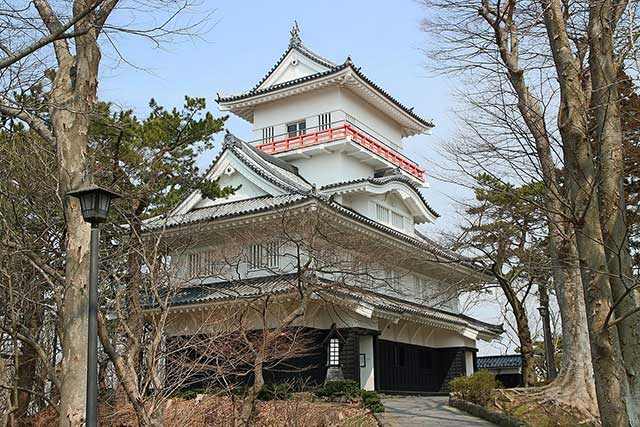
The founder of the castle is considered to be Satake Yoshinobu (1570–1633). Yoshinobu was one of the six great generals of Toyotomi Hideyoshi. During the Odawara Campaign of 1590, he took part in the siege of Oshi Castle under the command of Ishida Mitsunari, with whom Yoshinobu developed a good relationship.
-
Kavanhoe Castle
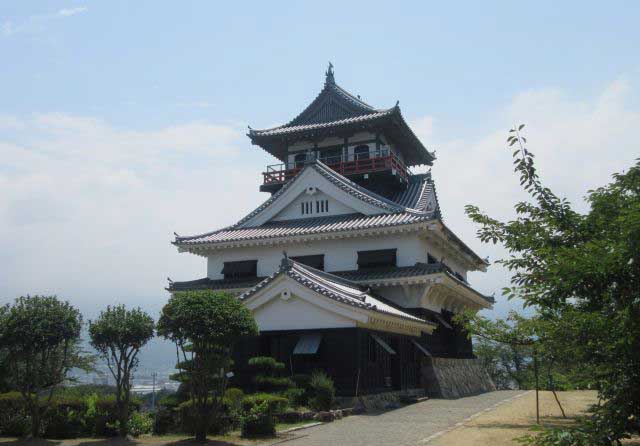
Kawanoe Castle is located on the small Wasi-yama hill near the port area of the Kawanoe district in the city of Shikokuchuo, occupying a central position along the northern coast of Shikoku Island. Kawanoe was also known as Butsuden Castle. The term “butsuden” in Japan refers to temple halls, and for this reason it is believed that a Buddhist temple once stood on the site before the castle was built. Due to its location at the junction of four provinces on Shikoku Island, Kawanoe held significant strategic importance and was repeatedly targeted by rival forces seeking military control over the region.
-
Yokote Castle
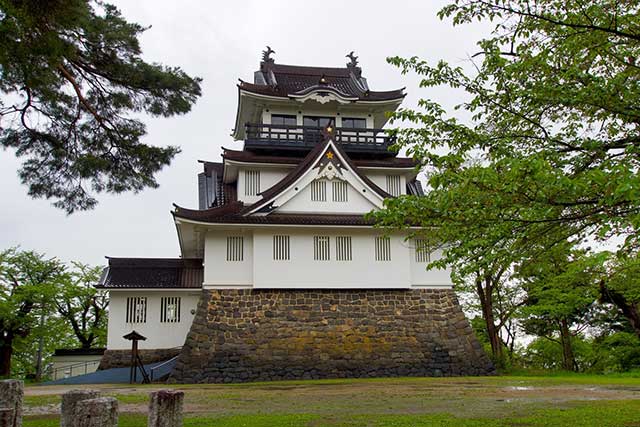
The founder of the castle is considered to be the Onodera clan. The Onodera were originally a minor clan from Shimotsuke Province and served Minamoto no Yoritomo (1147–1199), the founder of the first shogunate. The Onodera distinguished themselves in battle against the Fujiwara clan of the Ōshū branch and were rewarded with lands around Yokote. Around the 14th century, the Onodera moved to Yokote as their permanent residence. Their original stronghold was Numadate Castle, but after a series of clashes with the powerful Nambu clan, they relocated their base to the site of present-day Yokote Castle. It was likely during this time that the first fortifications appeared at the castle.