


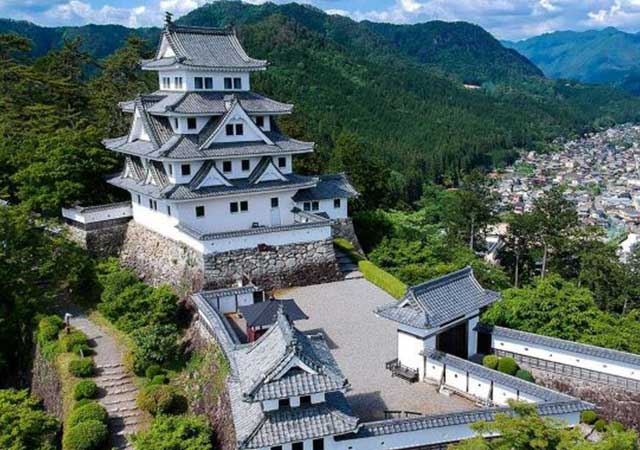
Gujo Hachiman Castle is located on 350-meter Mount Hachiman, near the confluence of the Yoshidagawa and Kodaragava rivers, and not far from the Nagaragawa River. During the Sengoku period, this area was of great strategic importance: it stood at a key crossroads of routes connecting Mino Province in the south with the Sea of Japan in the north, and Hida Province in the east with Echizen Province in the west.
It is generally believed that the first fortifications on Mount Hachiman already existed in the 15th century, when the area was controlled by the To clan. However, in the late 1550s, Endo Morikazu, the head of a cadet branch of the clan, rose in rebellion against the To. He attacked and destroyed Todonoyama Castle, which stood on the opposite bank of the river. After that, Morikazu decided to build his base on Mount Hachiman. Still, he managed to construct only the stone walls before his death interrupted his plans. The completion of the castle was left to his son, Endo Yoshitaka, and by 1559 the castle was fully finished.
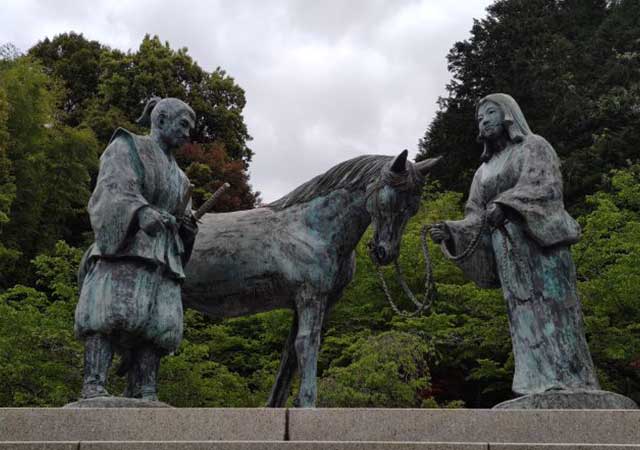
It was in Gujo Hachiman Castle that Endo Morikazu’s daughter, Endo Chiyo (1557–1617), was born. Chiyo is well known for a story connected to the horse of her husband, Yamauchi Kazutoyo. When Chiyo got married, her mother gave her a sum of 10 ryo (about 1.5 million yen in modern terms), meant to be used for an “especially important occasion.” Kazutoyo served in Oda Nobunaga’s army but could not afford a good horse. Warhorses were scarce and extremely expensive. Chiyo went searching and eventually bought her husband a black horse named Kagami Kurige, spending her entire dowry in the process. The horse greatly impressed Oda Nobunaga, and Kazutoyo was promoted, which in turn improved the fortunes of the Yamauchi clan. At the foot of Mount Hachiman, there is a monument that tells this legend.
Later, Endo Yoshitaka became a vassal of Oda Nobunaga. After Nobunaga’s death in 1582, Yoshitaka joined Oda Nobutaka and fought against Toyotomi Hideyoshi. When the coalition of Shibata Katsuie and Oda Nobutaka was defeated in 1583, Yoshitaka surrendered to Hideyoshi. The castle was confiscated and given to Inaba Sadamichi. Sadamichi rebuilt and strengthened the castle, and it was under him that Gujo Hachiman gained its donjon and most of its stone walls.
After Hideyoshi’s death in 1598, the Inaba clan initially supported Ishida Mitsunari. As a result, the castle was attacked by its former owner, Endo Yoshitaka, who sided with Tokugawa Ieyasu and hoped to reclaim his stronghold. After a short siege, the castle surrendered to Endo’s forces. However, the Inaba soon swore loyalty to the Tokugawa, and with Ieyasu’s backing, they regained control of the castle.
Later, the two former enemies—the Inaba and Endo clans—fought together for the Tokugawa in the Battle of Sekigahara in 1600. Ieyasu settled their long-standing dispute by granting the Inaba clan the Usuki Domain on the island of Kyushu. Gujo Hachiman Castle once again became the seat of Endo Yoshitaka. Between 1601 and 1603, the Endo clan rebuilt the castle once more, and in that form it remained until the end of the Edo period.
Gujo Hachiman Castle is usually classified as a mountain castle (yamajiro). However, only the main bailey was located at the summit, while the other baileys were arranged at the foot of the mountain. For that reason, the castle is more accurately described as a plains-and-mountain type castle (hirayamajiro).
The Endo clan governed the castle and the Gujo Domain for five generations. But in 1693, due to an internal conflict, the Endo clan was stripped of its rights, and Endo Tsunehisa was sent to a small territory in the Kanto region. Gujo Hachiman Castle was then given to the Inoue clan. After the Inoue, starting in 1697, the castle was controlled by the Kanamori clan. In 1758, the castle passed to the Aoyama clan, which held it for seven generations, up to the end of the Edo period.
In 1870, in accordance with the policies of the new Meiji government, the castle was completely dismantled, except for certain fragments of its walls.
In 1933, the castle’s tenshu (main keep) was reconstructed in wood. It consists of four tiers and five floors. Since no reliable information about the original appearance of the castle survived, the reconstruction used drawings of Ogaki Castle (where a historic keep still existed at that time) and Hikone Castle. Today, this is considered the oldest wooden reconstruction of a castle keep in Japan.
In 2020–2023, the castle underwent renovation, which included structural reinforcement work designed to improve earthquake resistance. A historical museum is located inside the keep, and the tower’s observation deck offers an excellent view of the town. In addition, two corner turrets (sumiyagura), sections of earthen-and-plaster walls (dobei), and one gate were reconstructed. On Mount Hachiman, beyond the stone walls, visitors can also find traces of earthen defensive works—remains of embankments and moats.
In 2017, the Japan Castle Society included Gujo Hachiman Castle in its list of the “Continued Top 100 Japanese Castles” (the so-called “Top 200”). Since 1955, the castle complex has held the status of a “prefectural historic site.” The castle was also known by the name Shikisui.
In the castle town, some samurai residences and merchant houses from the Edo and Meiji periods have been preserved. The district where these buildings stand is designated as a “Preservation District for Groups of Traditional Buildings.”
See also
-
Arato Castle
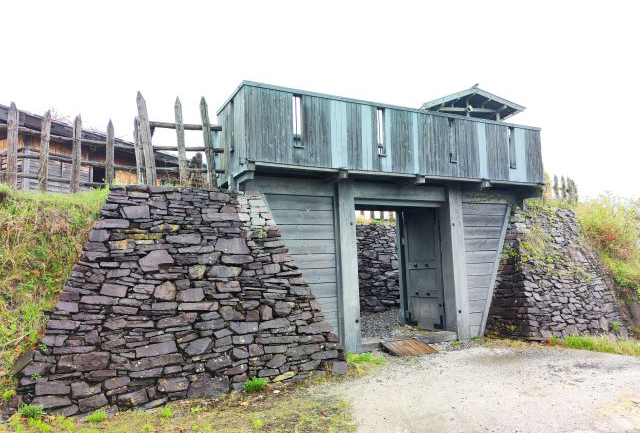
Arato Castle was built in 1524 by the Yamada clan under the orders of their overlord, Murakami, as a small mountain fort. Over time, it gained strategic importance and became a focal point in the conflict between two famous daimyō of the Sengoku period — Takeda Shingen and Murakami Yoshikiyo. This conflict turned the castle into one of the key fortifications in the struggle for control over Shinano Province.
-
Tatsuno Castle
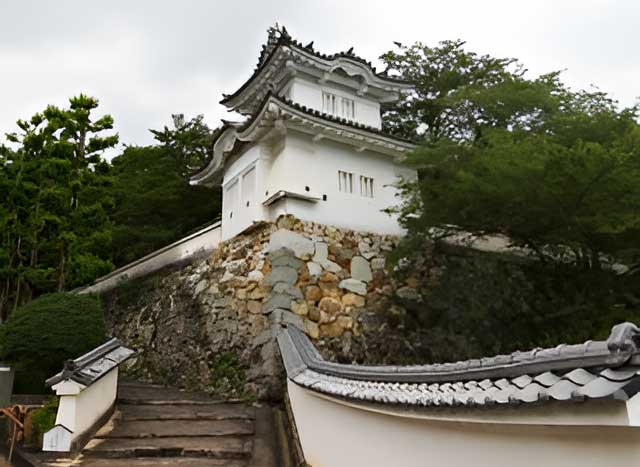
Tatsuno Castle is not a single fortification but rather a complex consisting of two parts: a mountain fortress located at the summit of Mount Keirozan and a flatland-mountain castle situated at its base. The mountain stronghold was built around 1499 by Akamatsu Murahide. During the Muromachi period, the Akamatsu clan was an influential family that, at the height of its power, controlled the provinces of Settsu, Harima, Bizen, and Mimasaka. Murahide’s ancestors were directly involved in the events of the Genkō War in the 14th century and in the subsequent establishment of the Ashikaga shogunate. However, by the 15th century, due to the process of gekokujō, the clan began to lose its position under pressure from rising families, including their former vassals—the Urakami and Bessho clans. In addition, the Akamatsu faced constant pressure from the Amago clan of Izumo Province.
-
Takamatsu Castle
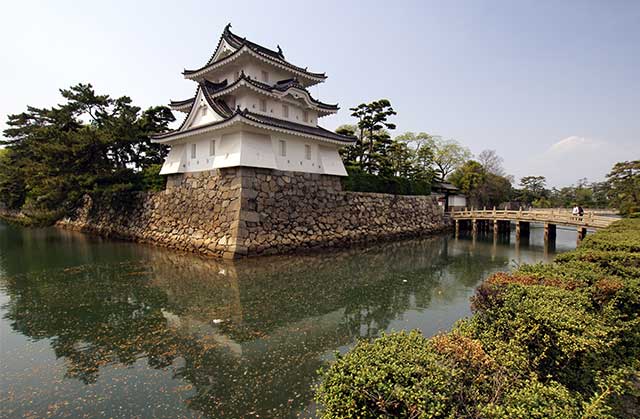
Takamatsu Castle was founded by Ikoma Chikamasa (1526–1603), who was appointed ruler of Takamatsu by Toyotomi Hideyoshi in 1587. The following year, Chikamasa began construction of the castle on the coast of the Inland Sea (Setonaikai), completing it by 1590.
-
Sawayama Castle
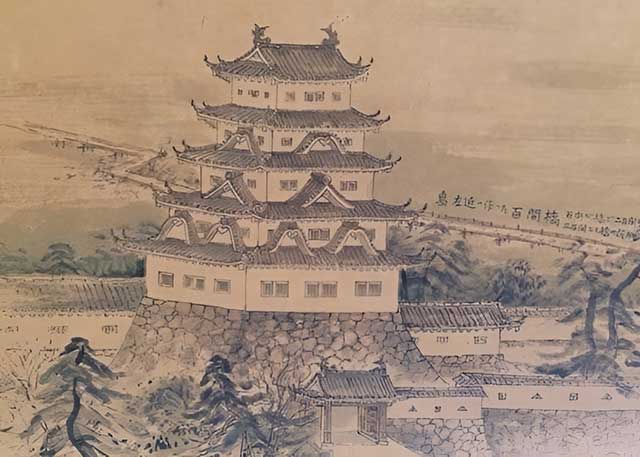
During the Kamakura period, Sabo Tokitsuna, the sixth son of Sasaki Sadatsuna, built a fort on Mount Sawayama. This fort occupied a strategically important position because it allowed control over traffic along the important Tōsandō route, which was later known as Nakasendō. This road connected the capital, Kyoto, with the eastern regions of the country. Due to its location, the fortification held great military importance, and during periods of civil war it repeatedly became the site of fierce battles.
-
Nadzima Castle
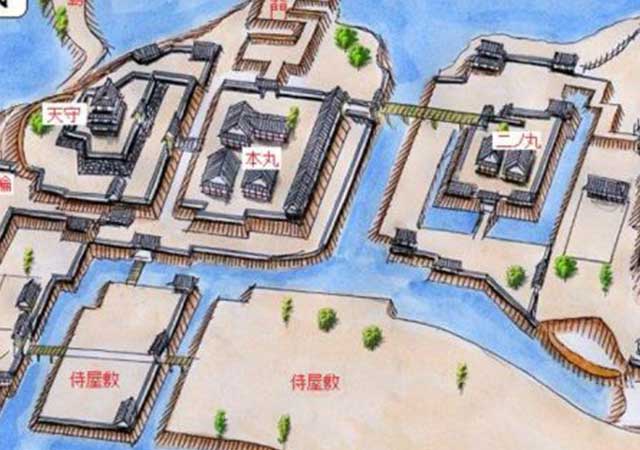
It is believed that the first structures on this site were built by Tachibana Akitoshi (?-1568), head of the Tachibana clan, a branch family of the Ōtomo clan, as auxiliary fortifications for Tachibanayama Castle. In 1587, Toyotomi Hideyoshi established control over the island of Kyushu and granted Chikuzen Province to Kobayakawa Takakage, one of the leading vassals of the Mori clan. Takakage began construction of a new castle on the site of the existing fortifications in 1588. The exact date of completion is unknown, but by the time the invasion of Korea began in 1592, the castle had already been finished, as records note that Toyotomi Hideyoshi stayed there overnight on his way to Hizen Nagoya Castle, which served as the headquarters of the invasion forces.
-
Kubota Castle
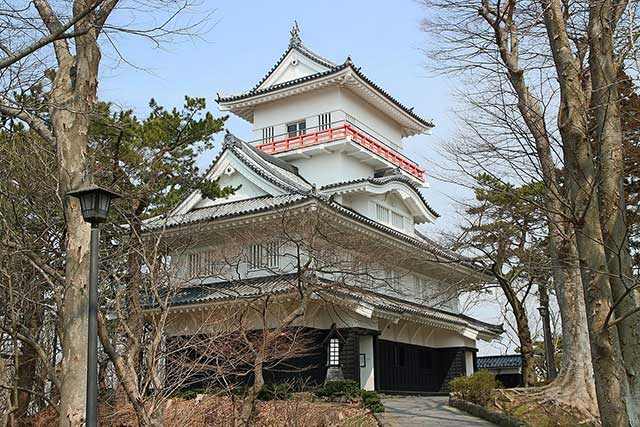
The founder of the castle is considered to be Satake Yoshinobu (1570–1633). Yoshinobu was one of the six great generals of Toyotomi Hideyoshi. During the Odawara Campaign of 1590, he took part in the siege of Oshi Castle under the command of Ishida Mitsunari, with whom Yoshinobu developed a good relationship.
-
Kavanhoe Castle
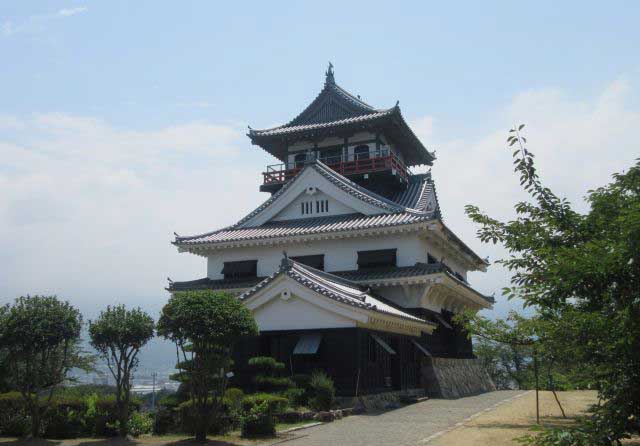
Kawanoe Castle is located on the small Wasi-yama hill near the port area of the Kawanoe district in the city of Shikokuchuo, occupying a central position along the northern coast of Shikoku Island. Kawanoe was also known as Butsuden Castle. The term “butsuden” in Japan refers to temple halls, and for this reason it is believed that a Buddhist temple once stood on the site before the castle was built. Due to its location at the junction of four provinces on Shikoku Island, Kawanoe held significant strategic importance and was repeatedly targeted by rival forces seeking military control over the region.
-
Yokote Castle
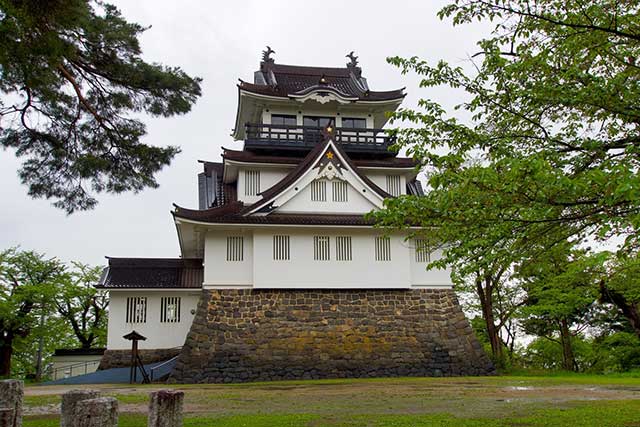
The founder of the castle is considered to be the Onodera clan. The Onodera were originally a minor clan from Shimotsuke Province and served Minamoto no Yoritomo (1147–1199), the founder of the first shogunate. The Onodera distinguished themselves in battle against the Fujiwara clan of the Ōshū branch and were rewarded with lands around Yokote. Around the 14th century, the Onodera moved to Yokote as their permanent residence. Their original stronghold was Numadate Castle, but after a series of clashes with the powerful Nambu clan, they relocated their base to the site of present-day Yokote Castle. It was likely during this time that the first fortifications appeared at the castle.