


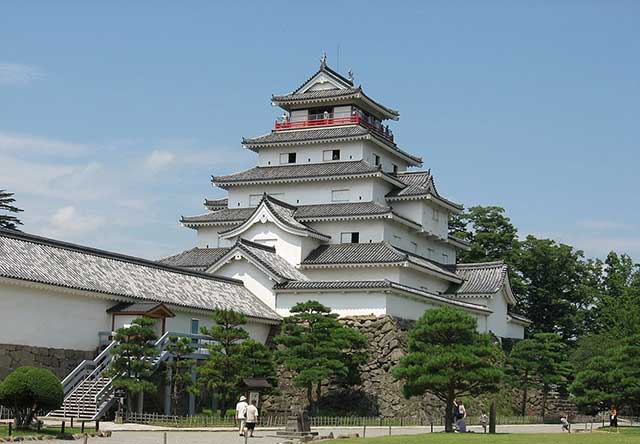
Aizu-Wakamatsu is the most powerful and at the same time the oldest castle in the Tōhoku region in the north of Honshu Island. Its history begins in the 14th century and is closely connected with the Ashina clan, whose members claimed descent from the legendary Taira family.
At the beginning of the 12th century, the Aizu region in Mutsu Province was ruled by Sawara Yoshitsuru, and his grandson adopted the surname Ashina, founding a new clan. In 1333, Ashina Naomori built his residence in Wakamatsu, which in 1384 was rebuilt into a full-scale castle and given the name Kurokawa. For many centuries, until the Meiji Restoration in 1868, it remained the main military and administrative center of the Aizu region.
In 1553, the castle and the region passed into the hands of Ashina Moriuji, who inherited them after the death of his father, Ashina Morikiyo. Moriuji significantly expanded the influence of the Ashina clan by taking lands from the Uesugi and Satake clans. These successes led to conflict with the Date clan, despite the former alliance between them. Contemporaries remembered Moriuji as a wise and just ruler under whom the region experienced economic prosperity. His reign is considered the golden age of the Ashina clan. In 1561, he withdrew from active rule to devote himself to the arts and handed power over to his son, Ashina Morioki.
Ashina Morioki proved to be an incapable ruler and died of alcoholism at the age of twenty-seven. After him, power passed to his adopted son, Ashina Moritaka, but because of his origins he lacked the support of the clan’s long-standing vassals and was soon killed as a result of a conspiracy. The new leader chosen was Ashina Morishige, Moritaka’s son-in-law and the son of the powerful daimyō Satake Yoshishige. His appointment also caused discontent, and many vassals defected to the young and charismatic Date Masamune. In 1585, the Ashina clan joined an alliance against Masamune led by the Hatakeyama clan. The combined army of thirty thousand men invaded Date territory.
Masamune attempted to stop the enemy with only seven thousand warriors but was defeated at the Battle of the Hitadori Bridge and retreated to Motomiya Castle. The allies prepared to storm the castle but received news that the Satake lands were under attack by the Satomi clan. After the Satake forces withdrew, the alliance collapsed and the siege was abandoned. In 1589, Masamune went on the offensive, invaded Aizu, captured Kurokawa Castle with relative ease, and completely destroyed the Ashina clan at the Battle of Suriagehara.
In 1590, Toyotomi Hideyoshi began his campaign against the Hōjō clan and invited Date Masamune to join him. Masamune was unable to do so in time and feared Hideyoshi’s wrath, so he appeared before him dressed in white garments symbolizing readiness to accept death. Hideyoshi appreciated the gesture and did not punish him, but Kurokawa Castle was confiscated and granted to Hideyoshi’s vassal, Gamō Ujisato. By 1592, Ujisato carried out a major reconstruction, building a seven-story tenshu keep, adding the Ninomaru and Sannomaru baileys, and renaming the castle Tsurugajō, or “Crane Castle.” Nevertheless, the new name did not take hold, and the castle came to be known as Aizu-Wakamatsu.
Gamō Ujisato was known not only as a military commander but also as a master of the tea ceremony and a patron of Sen no Rikyū. After Rikyū was forced to commit ritual suicide and his property was confiscated, Ujisato took in his adopted son, Sen Shōan, and brought him to Aizu-Wakamatsu. On the castle grounds, Shōan built the Rinkaku teahouse, which has survived to this day.
After Ujisato’s death in 1595, the castle was inherited by his son, Gamō Hideyuki, but he was soon transferred by Hideyoshi’s order to another domain with a sharp reduction in income. Aizu-Wakamatsu then passed to Uesugi Kagekatsu, the nephew and adopted son of Uesugi Kenshin. Kagekatsu took part in Hideyoshi’s campaigns and, after his death, became a member of the regency council. In 1600, he supported the Western Coalition and was defeated during the Sekigahara campaign, after which he lost a significant portion of his lands.
In 1611, the castle was damaged by an earthquake, and its restoration was completed under Katō Akinari in 1639. The keep became five stories tall, and this appearance later served as the basis for the modern reconstruction. In 1643, the castle was transferred to Hoshina Masayuki, the illegitimate son of the second shogun, Tokugawa Hidetada. His descendants, who bore the Matsudaira name, ruled Aizu-Wakamatsu for nearly 230 years, until the beginning of the Meiji period.
In 1852, the Aizu domain came under the rule of Matsudaira Katamori. In 1862, he was appointed military commissioner of Kyoto and formed the Rōshigumi unit, from which the famous Shinsengumi later emerged. After the transfer of power to the emperor in 1867 and the coup of 1868, the Boshin Civil War began. Katamori remained loyal to the shogunate and continued resistance in Aizu-Wakamatsu. As part of the Northern Alliance, the northern domains attempted to oppose the imperial forces but suffered defeat after defeat due to the lack of unified command.
In the fall of 1868, imperial troops broke through the defenses at the Bonari Pass and surrounded Aizu-Wakamatsu. The garrison numbered about five thousand men against an opposing army of fifteen thousand. After several failed assaults, a prolonged siege began. It was during this siege that the tragedy of the Byakkotai unit occurred, when nineteen young samurai committed seppuku, mistakenly believing that the castle had fallen.
On November 6, 1868, the garrison capitulated. The castle was severely damaged and was completely dismantled in 1874. During the demolition, monks from Amidadji Temple saved and relocated the three-story Gosangai turret. By the mid-20th century, only the moats, stone walls, and foundations of some structures remained on the castle grounds. In 1965, the main tenshu keep was reconstructed and converted into a museum. In subsequent years, the Kurogane Gate, galleries, and towers were rebuilt, and in 2011 the keep underwent renovation, during which the roof tiles were replaced with red ones.
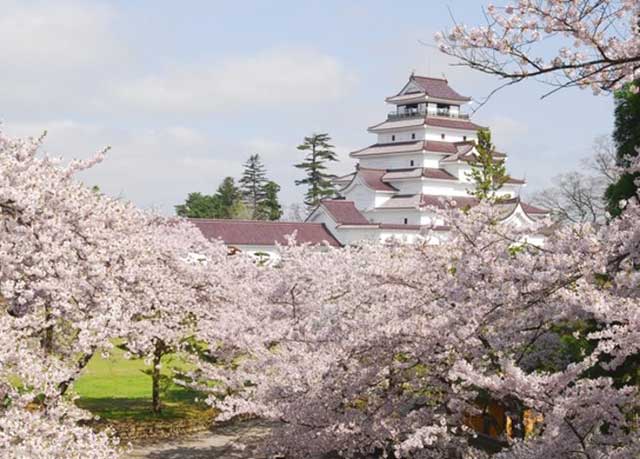
Today, Aizu-Wakamatsu Castle Park is considered one of the best places to view cherry blossoms. Since 1934, the castle complex has held the status of a National Historic Site, and in 2006 it was included in the list of the “100 Outstanding Castles of Japan.”
See also
-
Arato Castle
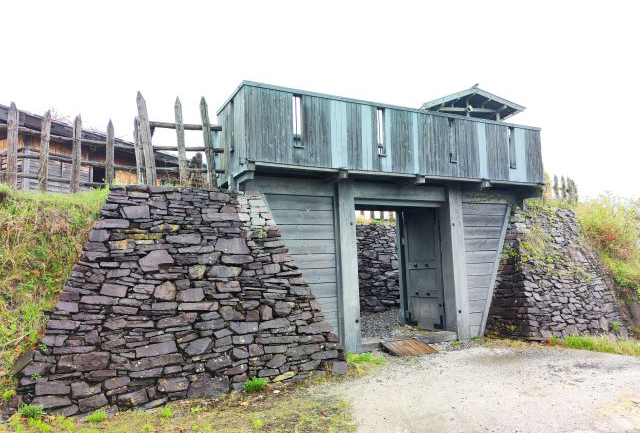
Arato Castle was built in 1524 by the Yamada clan under the orders of their overlord, Murakami, as a small mountain fort. Over time, it gained strategic importance and became a focal point in the conflict between two famous daimyō of the Sengoku period — Takeda Shingen and Murakami Yoshikiyo. This conflict turned the castle into one of the key fortifications in the struggle for control over Shinano Province.
-
Tatsuno Castle
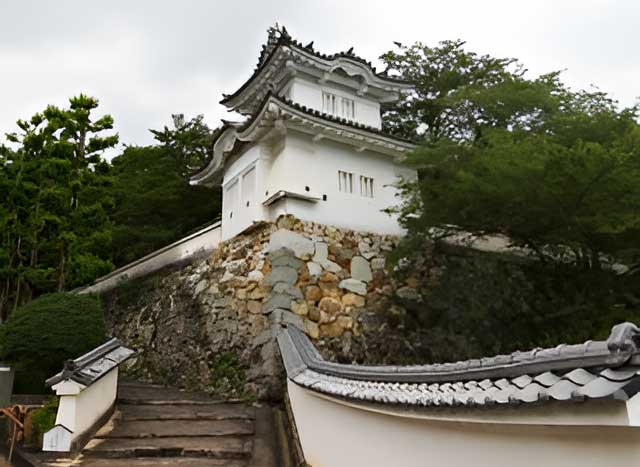
Tatsuno Castle is not a single fortification but rather a complex consisting of two parts: a mountain fortress located at the summit of Mount Keirozan and a flatland-mountain castle situated at its base. The mountain stronghold was built around 1499 by Akamatsu Murahide. During the Muromachi period, the Akamatsu clan was an influential family that, at the height of its power, controlled the provinces of Settsu, Harima, Bizen, and Mimasaka. Murahide’s ancestors were directly involved in the events of the Genkō War in the 14th century and in the subsequent establishment of the Ashikaga shogunate. However, by the 15th century, due to the process of gekokujō, the clan began to lose its position under pressure from rising families, including their former vassals—the Urakami and Bessho clans. In addition, the Akamatsu faced constant pressure from the Amago clan of Izumo Province.
-
Takamatsu Castle
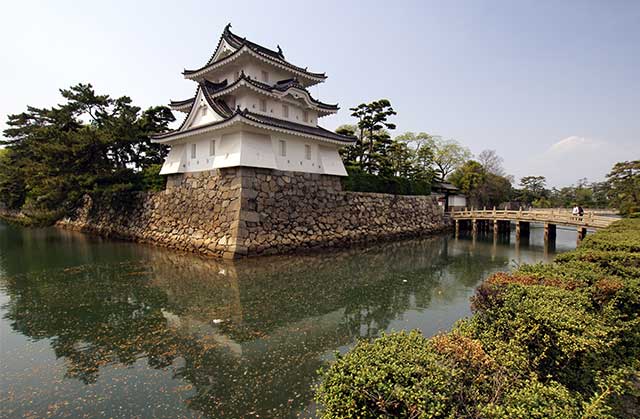
Takamatsu Castle was founded by Ikoma Chikamasa (1526–1603), who was appointed ruler of Takamatsu by Toyotomi Hideyoshi in 1587. The following year, Chikamasa began construction of the castle on the coast of the Inland Sea (Setonaikai), completing it by 1590.
-
Sawayama Castle
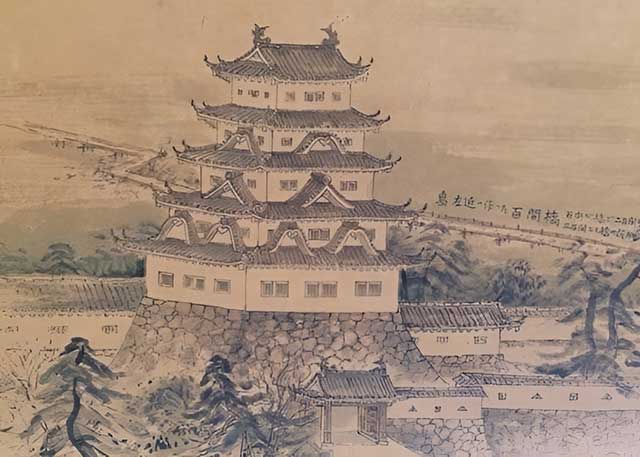
During the Kamakura period, Sabo Tokitsuna, the sixth son of Sasaki Sadatsuna, built a fort on Mount Sawayama. This fort occupied a strategically important position because it allowed control over traffic along the important Tōsandō route, which was later known as Nakasendō. This road connected the capital, Kyoto, with the eastern regions of the country. Due to its location, the fortification held great military importance, and during periods of civil war it repeatedly became the site of fierce battles.
-
Nadzima Castle
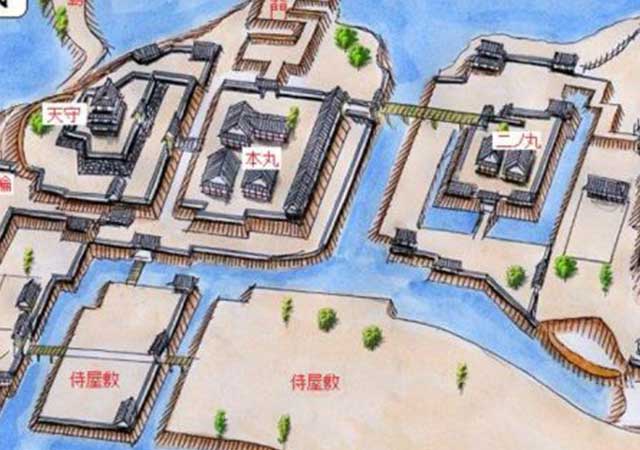
It is believed that the first structures on this site were built by Tachibana Akitoshi (?-1568), head of the Tachibana clan, a branch family of the Ōtomo clan, as auxiliary fortifications for Tachibanayama Castle. In 1587, Toyotomi Hideyoshi established control over the island of Kyushu and granted Chikuzen Province to Kobayakawa Takakage, one of the leading vassals of the Mori clan. Takakage began construction of a new castle on the site of the existing fortifications in 1588. The exact date of completion is unknown, but by the time the invasion of Korea began in 1592, the castle had already been finished, as records note that Toyotomi Hideyoshi stayed there overnight on his way to Hizen Nagoya Castle, which served as the headquarters of the invasion forces.
-
Kubota Castle
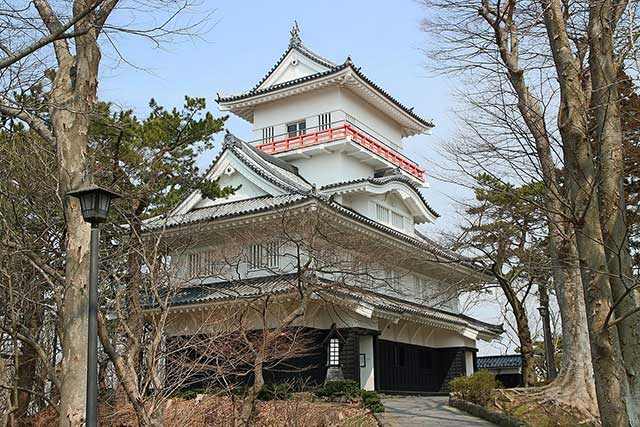
The founder of the castle is considered to be Satake Yoshinobu (1570–1633). Yoshinobu was one of the six great generals of Toyotomi Hideyoshi. During the Odawara Campaign of 1590, he took part in the siege of Oshi Castle under the command of Ishida Mitsunari, with whom Yoshinobu developed a good relationship.
-
Kavanhoe Castle
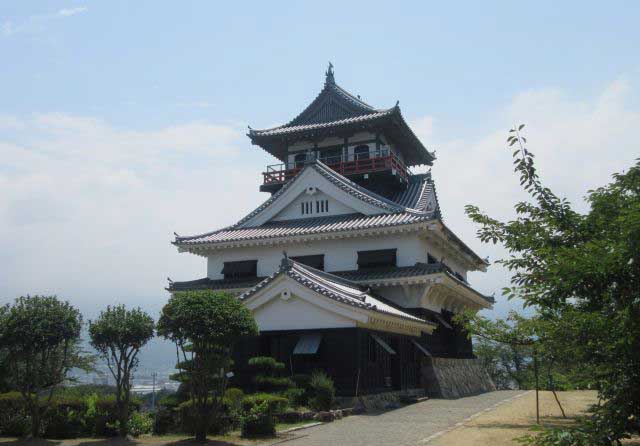
Kawanoe Castle is located on the small Wasi-yama hill near the port area of the Kawanoe district in the city of Shikokuchuo, occupying a central position along the northern coast of Shikoku Island. Kawanoe was also known as Butsuden Castle. The term “butsuden” in Japan refers to temple halls, and for this reason it is believed that a Buddhist temple once stood on the site before the castle was built. Due to its location at the junction of four provinces on Shikoku Island, Kawanoe held significant strategic importance and was repeatedly targeted by rival forces seeking military control over the region.
-
Yokote Castle
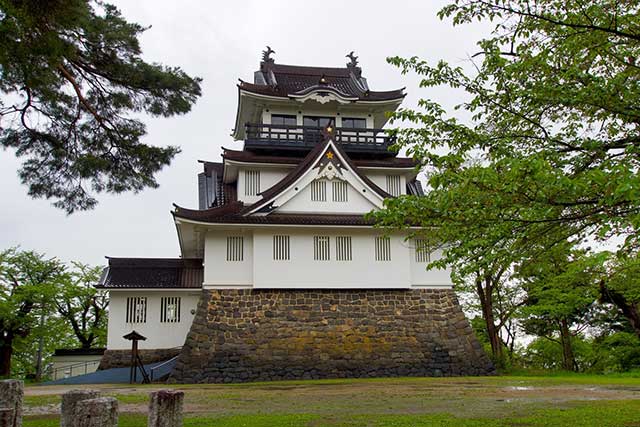
The founder of the castle is considered to be the Onodera clan. The Onodera were originally a minor clan from Shimotsuke Province and served Minamoto no Yoritomo (1147–1199), the founder of the first shogunate. The Onodera distinguished themselves in battle against the Fujiwara clan of the Ōshū branch and were rewarded with lands around Yokote. Around the 14th century, the Onodera moved to Yokote as their permanent residence. Their original stronghold was Numadate Castle, but after a series of clashes with the powerful Nambu clan, they relocated their base to the site of present-day Yokote Castle. It was likely during this time that the first fortifications appeared at the castle.