


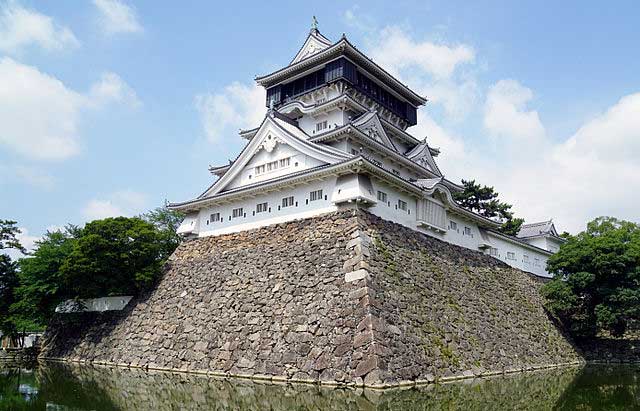
Kokura Castle is traditionally considered to have been founded by Hosokawa Tadaoki (1563–1645), although by the time the Hosokawa clan came to control these lands, the fortification had already existed since at least 1569 and was most likely built by members of the Mori clan.
Initially, Hosokawa Tadaoki served Oda Nobunaga. In the 1580s, he married Tама, the daughter of Akechi Mitsuhide (her Christian name was Gracia, 1563–1600). When Akechi Mitsuhide launched a rebellion that resulted in the death of Oda Nobunaga, he expected Tadaoki to support him in the struggle against Toyotomi Hideyoshi, one of Nobunaga’s former generals. However, Tadaoki refused to join Mitsuhide and later swore allegiance to Toyotomi Hideyoshi. As a vassal of Hideyoshi, he took part in the campaigns at Komaki and Odawara. In the 1590s, Tadaoki grew closer to Tokugawa Ieyasu, and in 1600, during the Sekigahara campaign, he sided with him. On the eve of the decisive battle, Ishida Mitsunari attempted to put pressure on his opponents by taking members of their families hostage, including Gracia, but she chose to take her own life instead.
At the Battle of Sekigahara, Tadaoki commanded a five-thousand-man force positioned at the vanguard of the Tokugawa army and took part in clashes with the troops of Shima Sakon. After the victory, he was rewarded with the Nakatsu domain in Buzen Province, and in 1602 he was granted the Kokura domain.
The main residence of his holdings was considered to be Nakatsu Castle, located on the eastern coast of Kyushu. However, Tadaoki decided to move the center of his domain to the northern part of the island, to an area where major transportation routes between Kyushu and Honshu converged. He began constructing a new castle, inviting skilled craftsmen and experienced builders from various regions of the country. Tadaoki also invested significant effort and resources into developing the castle town surrounding it. Construction was fully completed by 1608.
In 1620, Tadaoki abdicated in favor of his son Tadatoki (1586–1641), who became the second daimyo of the Kokura domain. In 1632, Hosokawa Tadatoki was transferred to Kumamoto Castle, and Kokura passed to a relative of the Hosokawa clan, Ogasawara Tadaazane (1596–1667). Tadaazane, a great-grandson of Tokugawa Ieyasu, came to Kokura from Akashi Castle. At his invitation, the Zen Buddhist monk Sokuhi, a representative of the Ōbaku school, arrived in the city, and several temples were built.
In 1634, at Tadaazane’s invitation, the renowned swordsman Miyamoto Musashi came to the castle. He lived in Kokura for seven years—the longest period he spent in one place throughout his life. During this time, the Niten Ichi-ryu school was established in the city, focusing primarily on the two-sword fighting technique developed and practiced by Musashi himself.
The Ogasawara clan controlled the castle for more than 230 years. In 1837, the Kokura donjon, along with the other buildings, was destroyed in a major fire. Two years later, the castle was restored, but the main tower was not rebuilt.
During the Bakumatsu period (1853–1869), the castle served as the headquarters for forces opposing the uprising of the Choshu clan against the shogunate. In 1866, the combined forces of the Kokura and Kumamoto domains attempted to suppress the rebellion but were defeated. The Ogasawara clan was forced to abandon Kokura Castle, which was set on fire by the retreating troops and burned to the ground. In 1869, the last Ogasawara daimyo, Tadanobu, transferred ownership of the castle to the emperor.
During World War II, the city of Kokura was designated as a secondary target for the first atomic bombing and the primary target for the second. However, the first bomb was dropped on the main target, Hiroshima, and a dense fog prevented the second bomb from being dropped on Kokura, leading to the selection of the alternate target, Nagasaki. Thus, Kokura narrowly escaped destruction twice.
After the war, the castle was confiscated by American occupation forces and returned to Japan in 1957.
In 1959, the castle’s main tower was reconstructed using reinforced concrete. This reconstruction is considered an example of a so-called “fake” castle, as its modern appearance differs significantly from the historical original: the donjon built by Hosokawa Tadaoki belonged to the simple sotogata type and had no gables. The present tower, by contrast, is decorated with numerous gables and can be classified as the namban-style, since its top floor is significantly larger than the one below it. The total height of the donjon is nearly 50 meters, about 19 meters of which are accounted for by the stone base. The tower consists of four tiers and five stories; the fifth story is larger than the fourth and features a panoramic observation deck. Since 1971, the donjon has housed a museum with an interesting collection of artifacts. By 1991, some of the castle’s secondary structures had also been reconstructed.
See also
-
Arato Castle
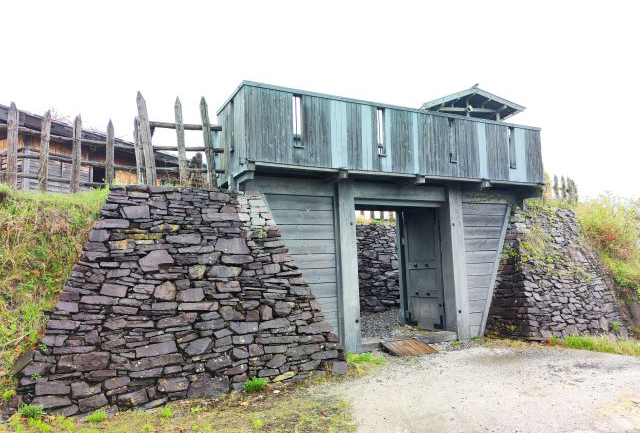
Arato Castle was built in 1524 by the Yamada clan under the orders of their overlord, Murakami, as a small mountain fort. Over time, it gained strategic importance and became a focal point in the conflict between two famous daimyō of the Sengoku period — Takeda Shingen and Murakami Yoshikiyo. This conflict turned the castle into one of the key fortifications in the struggle for control over Shinano Province.
-
Tatsuno Castle
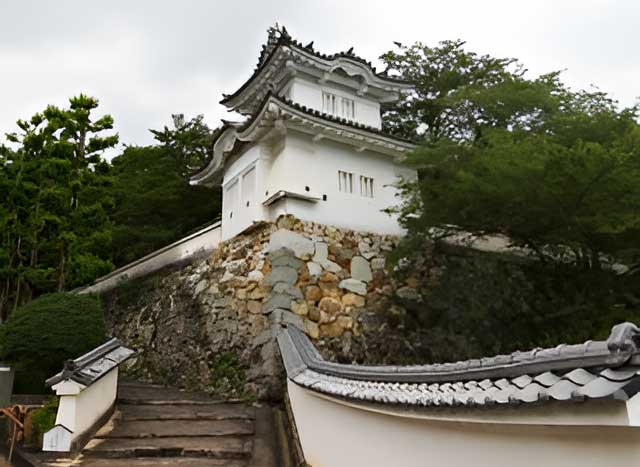
Tatsuno Castle is not a single fortification but rather a complex consisting of two parts: a mountain fortress located at the summit of Mount Keirozan and a flatland-mountain castle situated at its base. The mountain stronghold was built around 1499 by Akamatsu Murahide. During the Muromachi period, the Akamatsu clan was an influential family that, at the height of its power, controlled the provinces of Settsu, Harima, Bizen, and Mimasaka. Murahide’s ancestors were directly involved in the events of the Genkō War in the 14th century and in the subsequent establishment of the Ashikaga shogunate. However, by the 15th century, due to the process of gekokujō, the clan began to lose its position under pressure from rising families, including their former vassals—the Urakami and Bessho clans. In addition, the Akamatsu faced constant pressure from the Amago clan of Izumo Province.
-
Takamatsu Castle
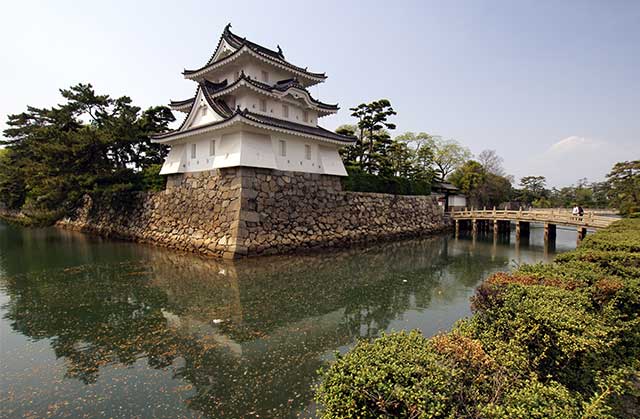
Takamatsu Castle was founded by Ikoma Chikamasa (1526–1603), who was appointed ruler of Takamatsu by Toyotomi Hideyoshi in 1587. The following year, Chikamasa began construction of the castle on the coast of the Inland Sea (Setonaikai), completing it by 1590.
-
Sawayama Castle
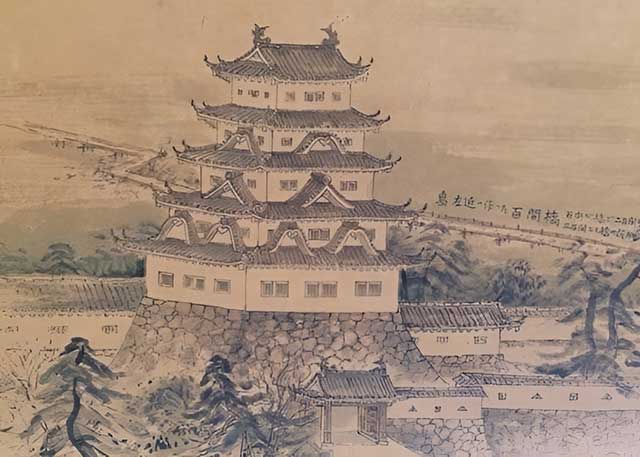
During the Kamakura period, Sabo Tokitsuna, the sixth son of Sasaki Sadatsuna, built a fort on Mount Sawayama. This fort occupied a strategically important position because it allowed control over traffic along the important Tōsandō route, which was later known as Nakasendō. This road connected the capital, Kyoto, with the eastern regions of the country. Due to its location, the fortification held great military importance, and during periods of civil war it repeatedly became the site of fierce battles.
-
Nadzima Castle
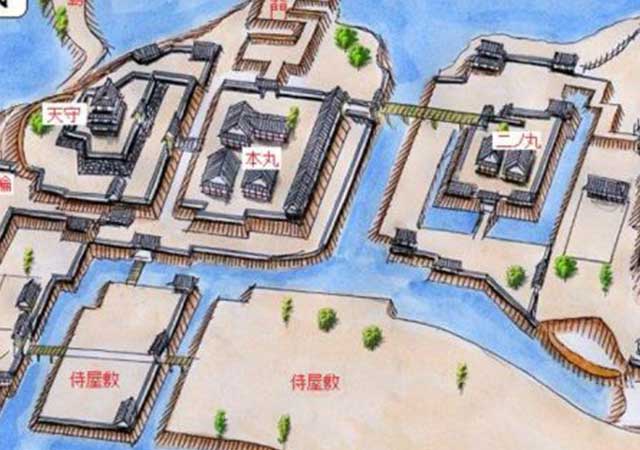
It is believed that the first structures on this site were built by Tachibana Akitoshi (?-1568), head of the Tachibana clan, a branch family of the Ōtomo clan, as auxiliary fortifications for Tachibanayama Castle. In 1587, Toyotomi Hideyoshi established control over the island of Kyushu and granted Chikuzen Province to Kobayakawa Takakage, one of the leading vassals of the Mori clan. Takakage began construction of a new castle on the site of the existing fortifications in 1588. The exact date of completion is unknown, but by the time the invasion of Korea began in 1592, the castle had already been finished, as records note that Toyotomi Hideyoshi stayed there overnight on his way to Hizen Nagoya Castle, which served as the headquarters of the invasion forces.
-
Kubota Castle
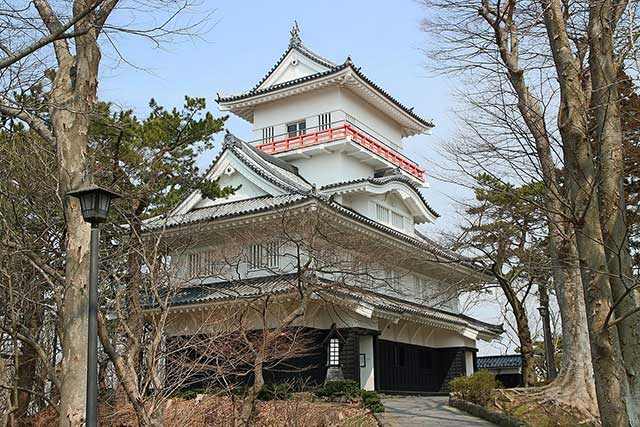
The founder of the castle is considered to be Satake Yoshinobu (1570–1633). Yoshinobu was one of the six great generals of Toyotomi Hideyoshi. During the Odawara Campaign of 1590, he took part in the siege of Oshi Castle under the command of Ishida Mitsunari, with whom Yoshinobu developed a good relationship.
-
Kavanhoe Castle
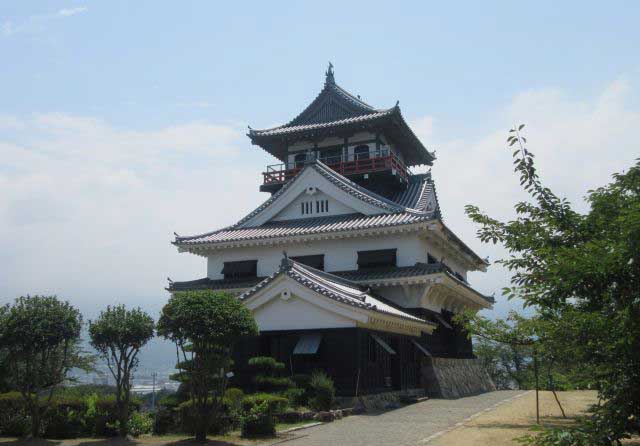
Kawanoe Castle is located on the small Wasi-yama hill near the port area of the Kawanoe district in the city of Shikokuchuo, occupying a central position along the northern coast of Shikoku Island. Kawanoe was also known as Butsuden Castle. The term “butsuden” in Japan refers to temple halls, and for this reason it is believed that a Buddhist temple once stood on the site before the castle was built. Due to its location at the junction of four provinces on Shikoku Island, Kawanoe held significant strategic importance and was repeatedly targeted by rival forces seeking military control over the region.
-
Yokote Castle
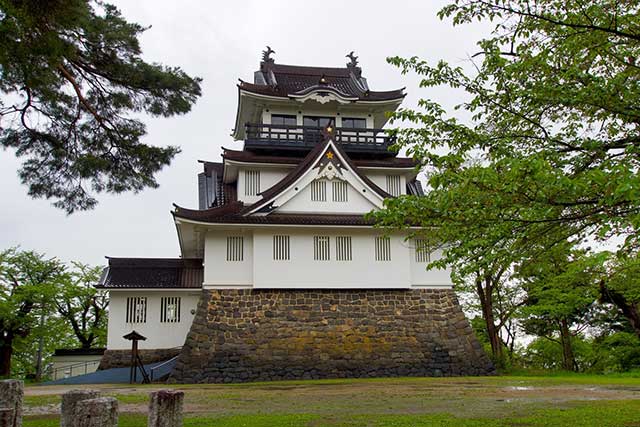
The founder of the castle is considered to be the Onodera clan. The Onodera were originally a minor clan from Shimotsuke Province and served Minamoto no Yoritomo (1147–1199), the founder of the first shogunate. The Onodera distinguished themselves in battle against the Fujiwara clan of the Ōshū branch and were rewarded with lands around Yokote. Around the 14th century, the Onodera moved to Yokote as their permanent residence. Their original stronghold was Numadate Castle, but after a series of clashes with the powerful Nambu clan, they relocated their base to the site of present-day Yokote Castle. It was likely during this time that the first fortifications appeared at the castle.