


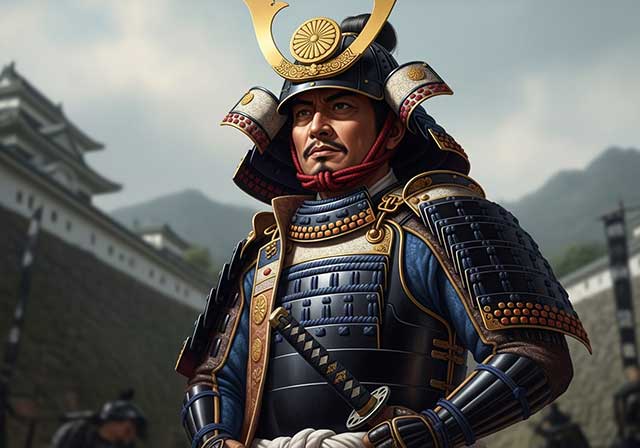
Hōjō Nagaudji was one of the prominent military commanders of the late Muromachi period. Thanks to a successful marriage alliance and skillful use of political intrigue, he managed to concentrate full power over the provinces of Suruga, Izu, and Sagami in his own hands. His origins remain unclear, but there is a possibility that he was connected to the Heiji clan of Ise Province, since early in his life he bore the name Ise Shinkurō.
In time, he arranged the marriage of his son Ujitsuna to a woman from the ancient and noble Hōjō family and himself adopted this surname—primarily to enhance his prestige, and possibly also to declare his political ambitions. The line he founded became known in history as the Go-Hōjō, that is, the “Later Hōjō.”
During the Ōnin disturbances, around 1475, Hōjō Nagaudji left his native lands and fled to Suruga Province, where he entered the service of the Imagawa clan under the protection of his relative Imagawa Yoshitada. After Yoshitada’s death in 1476, when a fierce internal conflict erupted within the clan, Shinkurō supported his nephew Yoshitaka. In gratitude for this assistance, Yoshitaka granted him Kokokuji Castle, a detachment of samurai, and the right to use a character from his own name. From that moment, the former novice Shinkurō became a close associate of one of the most powerful feudal lords of his time and the commander of a castle, now known as Ise Nagaudji.
Another opportunity to rise even higher appeared in 1490, when Ashikaga Tadamaro, the son of the daimyō of the neighboring province of Izu, murdered his father, mother, and younger brother, who had been named the heir. Without hesitation, Nagaudji surrounded the patricide with his troops in Horigoe Castle, where the latter soon took his own life. The vassals of the Ashikaga clan, without much regret, went over to Nagaudji’s side, and he thus took control of the entire province and adopted the ancient samurai surname Hōjō. After this, his attention was drawn to Odawara Castle, located nearby in Sagami Province.
Odawara was exceptionally well situated from a strategic standpoint and made it possible to control the entire Kantō Plain. The castle was owned by the young lord Ōmori Fujiyori. Having gained his trust, Nagaudji invited the lord on a deer hunt in 1495 and killed him there. Thus, in 1495, the Hōjō clan also took possession of Sagami Province.
Skillful diplomacy and a well-trained army enabled Nagaudji’s descendants to defeat the powerful Uesugi clan, which had ruled Kantō for two hundred years, and by the middle of the sixteenth century to expand their domains to eight provinces.
Nagaudji himself did not live to see this. In his old age, he took monastic vows and became known by his final name, Sōun, which means “Swift Cloud.” He died in 1519, leaving his son a remarkable set of family precepts known as the “Twenty-One Rules of Hōjō Sōun.”
These twenty-one rules were written shortly after Hōjō Sōun became a monk and reflected the entirety of his accumulated life experience. They established standards of behavior and a way of life for the ordinary warrior and show that their author was well acquainted with the daily life of the lower social strata. The range of advice contained in the rules is extraordinarily broad: from exhortations to study poetry, to master the art of horseback riding, and prohibitions against playing chess and go, to instructions on how best to defend one’s home and maintain order within it. All of the precepts are permeated by a spirit of self-confidence, which was both a result of Hōjō Sōun’s characteristic attention to detail and a reflection of his life path, through which he reached the heights of power.
Having achieved the pinnacle of power by the sword and stepping over the bodies of others, Sōun nevertheless did not become hardened. He governed his domains simply and wisely, reducing taxes to the necessary minimum, resolving disputes among his subjects fairly, and caring more about the welfare of his vassals than about his own wealth. Seeking to attract as many samurai as possible to Odawara, he reduced the tax burden from one-half of the harvest to two-fifths and, in general, took care of the people’s well-being.
Hōjō Sōun, like Asakura Toshikage, did not enjoy special esteem among historians. The reason for this was his ruthlessness and cruelty, with which he expanded his lands as a typical bloodthirsty gekokujō daimyō, opening the Age of the Warring Provinces. His contemporaries, on the contrary, highly valued his outstanding talent as a military commander and a capable administrator.
See also
-
Takeda Nobuyoshi
Takeda Nobuyoshi (1128–1186 or later) was a prominent Japanese samurai lord of the late Heian and early Kamakura periods and the founder of the Takeda clan.
-
Tokugawa Iemochi
Tokugawa Iemochi (1846–1866) was the fourteenth shōgun of the Tokugawa shogunate and ruled from 1858 until his death. His reign came during the turbulent final years of the shogunate, when Japan faced growing Western pressure and serious internal political conflict.
-
Tokugawa Ienari
Tokugawa Ienari (1773–1841) was the eleventh shōgun of the Tokugawa shogunate and ruled from 1787 to 1837, making him the longest-serving Tokugawa shōgun. He was a great-grandson of the eighth shōgun, Tokugawa Yoshimune.
-
Matsudaira Nobuyasu
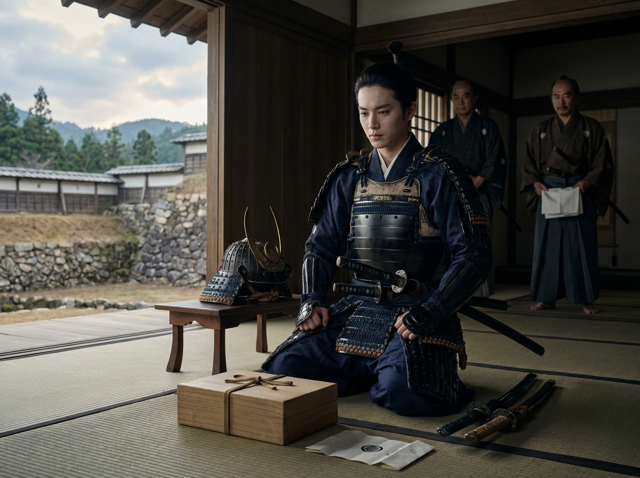
Matsudaira Nobuyasu was only twenty years old when his father ordered him to commit seppuku. The reason was not a defeat in battle, but a crisis inside the Tokugawa family that had become too dangerous to ignore.
-
Yamagata Masakage
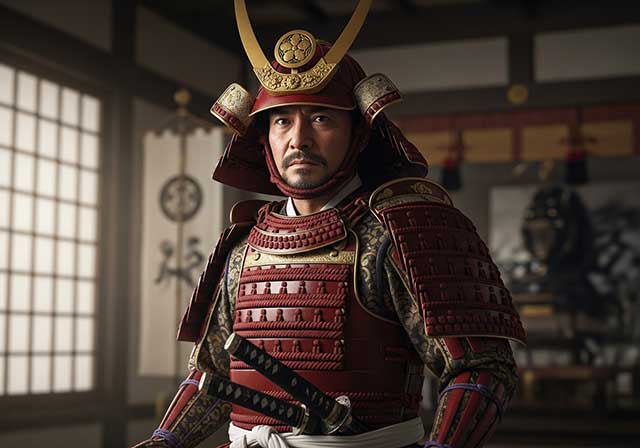
Masakage was one of Takeda Shingen’s most loyal and capable commanders. He was included in the famous list of the “Twenty-Four Generals of Takeda Shingen” and also belonged to the inner circle of four especially trusted warlords known as the Shitennō.
-
Yagyu Munenori
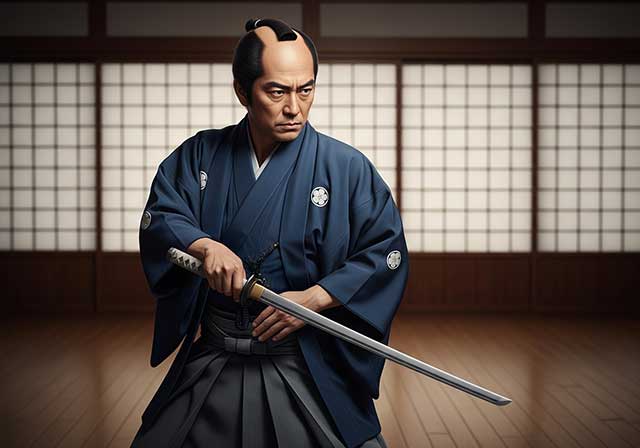
Yagyū Munenori began his service under Tokugawa Ieyasu while his father, Yagyū Muneyoshi, was still at his side. In 1600, Munenori took part in the decisive Battle of Sekigahara. As early as 1601, he was appointed a kenjutsu instructor to Tokugawa Hidetada, Ieyasu’s son, who later became the second shogun of the Tokugawa clan.
-
Yagyu Muneyoshi
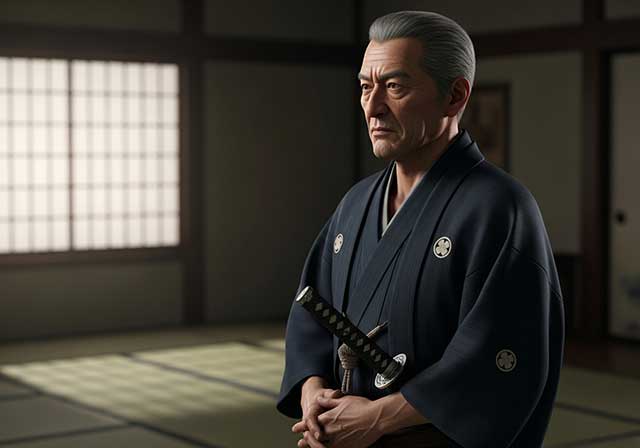
A samurai from Yamato Province, he was born into a family that had been defeated in its struggle against the Tsutsui clan. Muneyoshi first took part in battle at the age of sixteen. Due to circumstances beyond his control, he was forced to enter the service of the Tsutsui house and later served Miyoshi Tōkei. He subsequently came under the command of Matsunaga Hisahide and in time became a vassal first of Oda and later of Toyotomi.
-
Endo Naozune
Naozune served under Azai Nagamasa and was one of the clan’s leading vassals, renowned for his bravery and determination. He accompanied Nagamasa during his first meeting with Oda Nobunaga and at that time asked for permission to kill Nobunaga, fearing him as an extremely dangerous man; however, Nagamasa did not grant this request.