

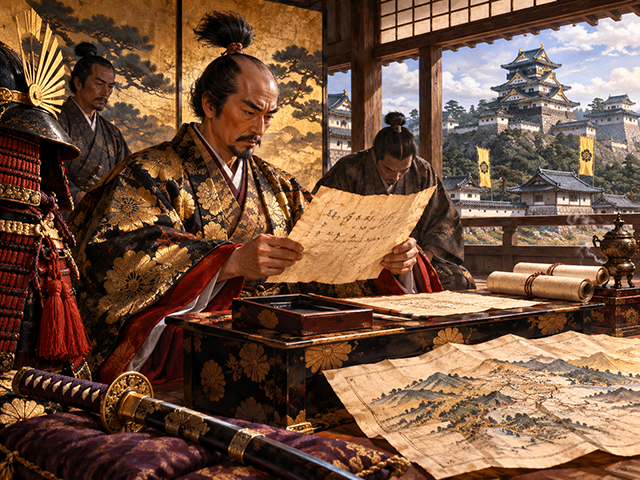
A previously unknown letter from Toyotomi Hideyoshi, one of Japan's great unifiers, has been publicly displayed for the first time. Written in 1585, the document reveals how Hideyoshi granted Yamato Province to his younger brother, Hidenaga, and attempted to resolve complicated questions of loyalty among local samurai families.
On September 29, 2026, Osaka Castle Museum announced the discovery of a historical document previously unknown to researchers. The red-seal letter, addressed to the warlord Gamo Ujisato, is dated the fourth day of the ninth month of 1585 in the traditional Japanese calendar.
The document is being exhibited for the first time during the special exhibition Sengoku Siblings, held at Osaka Castle from October 10 through November 23, 2026.
What makes this discovery remarkable is that the letter does not describe another famous battle. Instead, it provides an unusually direct glimpse into the administrative decisions that helped Hideyoshi consolidate power over Japan.
Japan in 1585: From Military Victory to Political Control
The second half of the sixteenth century was part of Japan's Sengoku period, an era marked by civil wars, rival military leaders, and an extended struggle to bring the country under unified rule.
Following the death of Oda Nobunaga in 1582, his former general Toyotomi Hideyoshi gradually established himself as Japan's dominant political figure.
By 1585, Hideyoshi's authority had grown considerably. That year, he became kampaku, the imperial regent, while his forces completed the campaign to subjugate the island of Shikoku.
One of the leading participants in that campaign was Hideyoshi's younger brother, Toyotomi Hidenaga.
As a reward for his military service, Hidenaga received Yamato Province, approximately corresponding to present-day Nara Prefecture in central Japan.
However, transferring a province to a new ruler required much more than issuing an appointment.
Local samurai families held lands, maintained relationships with powerful warlords, and owed obligations to their existing masters. These relationships did not necessarily correspond to the new territorial boundaries.
The newly discovered letter reveals how Hideyoshi addressed that problem.
Five Thousand People Enter Koriyama Castle
According to Osaka Castle Museum, Hideyoshi and Hidenaga entered Koriyama Castle together on the third day of the ninth month of 1585.
They were accompanied by approximately 5,000 people.
For the province's new ruler, this was a significant public demonstration of authority. Hideyoshi's presence showed that Hidenaga enjoyed the direct support of Japan's most powerful political leader.
The following day, Hideyoshi sent a letter to Gamo Ujisato, an influential warlord who controlled Matsugashima Castle in Ise Province.
In the document, Hideyoshi explained that Yamato's previous ruler, Tsutsui Sadatsugu, had been transferred to Iga Province. Hideyoshi himself had arrived at Koriyama to arrange the new administration.
The letter also confirmed that Hidenaga had been granted both Yamato and Kii provinces.
Two Samurai Families and a Problem of Divided Loyalty
The most revealing section of the letter concerns the Sawa and Akiyama families.
These local warrior families held land in Yamato's Uda District, but they had previously served Gamo Ujisato, whose own power base lay in neighboring Ise Province.
This created a complicated situation.
Their lands lay within Hidenaga's newly assigned territory, but their obligations as retainers connected them to another lord.
Such overlapping relationships could create uncertainty about who possessed authority over the warriors living inside the province.
Hideyoshi proposed two solutions.
The first option: The Sawa and Akiyama families could reside in Koriyama, enter Hidenaga's service, and receive support from him.
The second option: Ujisato could bring the families into Ise and retain them in his own service.
Remarkably, Hideyoshi allowed Ujisato to choose between these arrangements.
He also instructed that both families be informed and asked Ujisato to explain the decision to them.
The letter therefore provides a concrete example of how overlapping feudal obligations could be reorganized under Hideyoshi's authority.
Why Did Hideyoshi Intervene Personally?
In sixteenth-century Japan, a warlord's power depended on more than the number of soldiers he commanded or the size of his territory.
His authority also relied on relationships with the samurai families who controlled local land and provided military service.
Transferring a province could disrupt existing obligations, incomes, and political relationships.
The newly discovered document demonstrates that Hideyoshi did not simply appoint his younger brother as the new ruler of Yamato.
He became directly involved in organizing the administration, issuing instructions to powerful retainers, and attempting to establish clearer lines of authority.
According to Osaka Castle Museum's interpretation, these measures were intended to create a unified system of territorial control under Hidenaga.
The letter also highlights the brothers' close political cooperation.
Hidenaga was not merely a relative rewarded with extensive lands. He played an important role in building the emerging political order, while Hideyoshi personally supported his authority.
How Was the Letter Authenticated?
The document had been preserved in a private collection before its owner brought it to Osaka Castle Museum for examination.
Museum specialists studied its red seal, the quality and characteristics of the paper, the handwriting, and the document's contents.
After examining this evidence, the museum concluded that it was an authentic letter issued by Hideyoshi.
The surviving sheet measures approximately 5.6 by 34 inches (14.3 by 86.4 centimeters).
According to the museum, approximately 7,000 documents associated with Hideyoshi are known when both originals and copies are counted. Most are included in a major collection compiled by the Nagoya City Museum.
The newly discovered letter was not included in that collection.
It therefore represents an additional historical source that offers fresh insight into Hideyoshi's political decisions.
What Does the Discovery Reveal About the Unification of Japan?
The story of Toyotomi Hideyoshi is often told through military campaigns, castle sieges, and victories over powerful rivals.
But creating a more unified political order required more than battlefield success.
It also required redistributing territories, establishing administrative authority, and clarifying the relationships between local warrior families and their new rulers.
The 1585 letter reveals this process through one specific decision.
The transfer of Yamato to Hidenaga involved not only a ceremonial arrival at Koriyama Castle but also detailed negotiations over the loyalties of local samurai families.
The document does not establish every subsequent consequence for the Sawa and Akiyama families. It does, however, show which problems Hideyoshi considered important enough to address personally.
Decisions of this kind, alongside military victories, helped transform Sengoku Japan's fragmented political landscape into a more centralized system of government.
Where Can the Letter Be Seen?
The document is on display during the special exhibition Sengoku Siblings at Osaka Castle Museum.
The exhibition explores the importance of family relationships, cooperation, and rivalry among the brothers and sisters of Japan's Sengoku-era warlords.
- Location: Osaka Castle Museum, third and fourth floors.
- Dates: October 10 – November 23, 2026.
- Exhibits: 97 items.
Primary source: Osaka City Government and Osaka Castle Museum, official announcement published September 29, 2026.
See also
-
The 16-Year-Old Samurai Who Crossed the Pacific and Discovered America in 1860
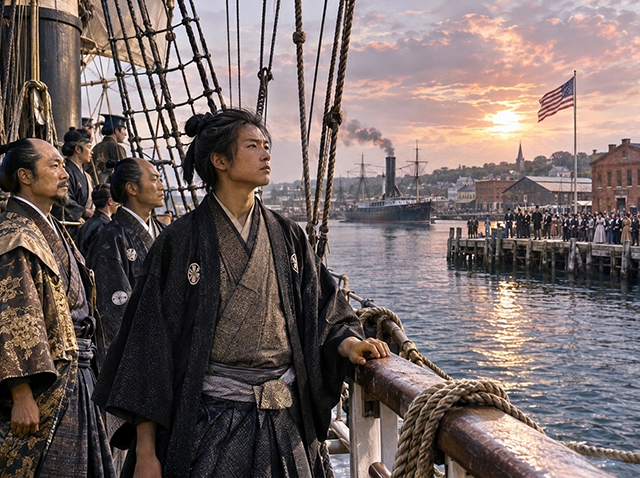
A new historical exhibition in Japan tells the remarkable story of a teenage samurai who crossed the Pacific Ocean aboard the Kanrin Maru at just sixteen years old. His surviving travel writings offer a rare opportunity to experience America in 1860 through the eyes of a young Japanese traveler who witnessed one of the most important diplomatic journeys of his time.
-
Arato Castle
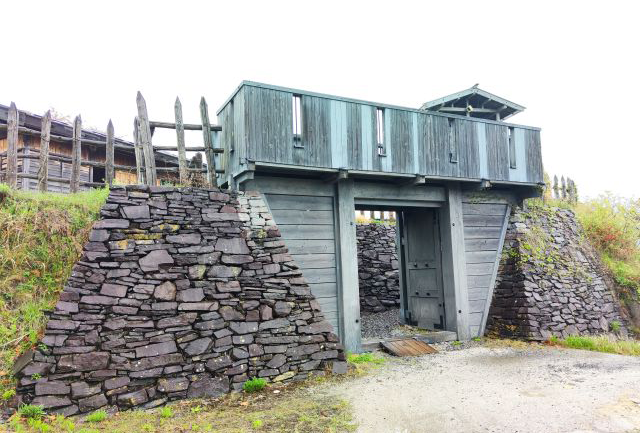
Arato Castle was built in 1524 by the Yamada clan under the orders of their overlord, Murakami, as a small mountain fort. Over time, it gained strategic importance and became a focal point in the conflict between two famous daimyō of the Sengoku period — Takeda Shingen and Murakami Yoshikiyo. This conflict turned the castle into one of the key fortifications in the struggle for control over Shinano Province.
-
Tatsuno Castle
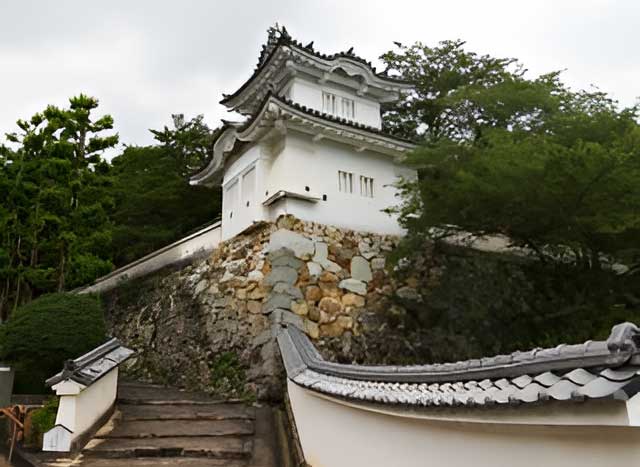
Tatsuno Castle is not a single fortification but rather a complex consisting of two parts: a mountain fortress located at the summit of Mount Keirozan and a flatland-mountain castle situated at its base. The mountain stronghold was built around 1499 by Akamatsu Murahide. During the Muromachi period, the Akamatsu clan was an influential family that, at the height of its power, controlled the provinces of Settsu, Harima, Bizen, and Mimasaka. Murahide’s ancestors were directly involved in the events of the Genkō War in the 14th century and in the subsequent establishment of the Ashikaga shogunate. However, by the 15th century, due to the process of gekokujō, the clan began to lose its position under pressure from rising families, including their former vassals—the Urakami and Bessho clans. In addition, the Akamatsu faced constant pressure from the Amago clan of Izumo Province.
-
Takamatsu Castle
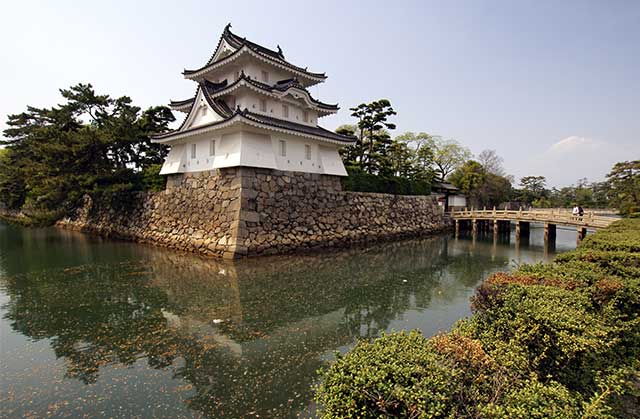
Takamatsu Castle was founded by Ikoma Chikamasa (1526–1603), who was appointed ruler of Takamatsu by Toyotomi Hideyoshi in 1587. The following year, Chikamasa began construction of the castle on the coast of the Inland Sea (Setonaikai), completing it by 1590.
-
Sawayama Castle
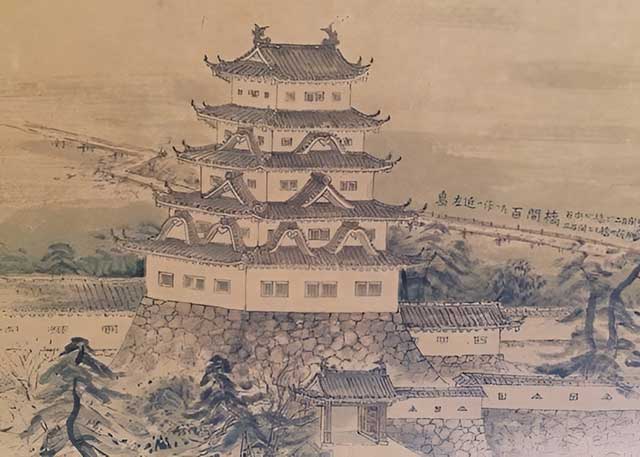
During the Kamakura period, Sabo Tokitsuna, the sixth son of Sasaki Sadatsuna, built a fort on Mount Sawayama. This fort occupied a strategically important position because it allowed control over traffic along the important Tōsandō route, which was later known as Nakasendō. This road connected the capital, Kyoto, with the eastern regions of the country. Due to its location, the fortification held great military importance, and during periods of civil war it repeatedly became the site of fierce battles.
-
Nadzima Castle
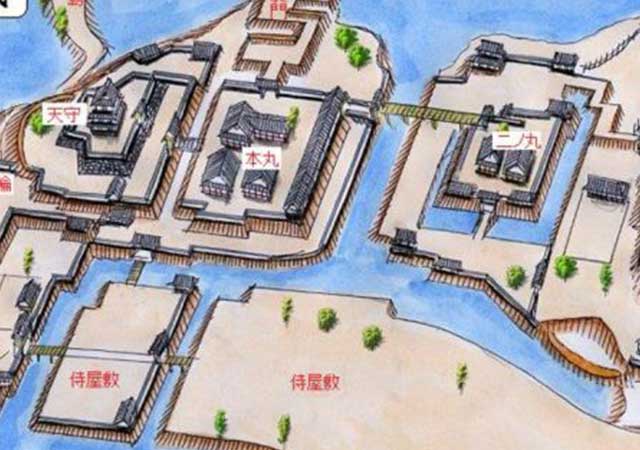
It is believed that the first structures on this site were built by Tachibana Akitoshi (?-1568), head of the Tachibana clan, a branch family of the Ōtomo clan, as auxiliary fortifications for Tachibanayama Castle. In 1587, Toyotomi Hideyoshi established control over the island of Kyushu and granted Chikuzen Province to Kobayakawa Takakage, one of the leading vassals of the Mori clan. Takakage began construction of a new castle on the site of the existing fortifications in 1588. The exact date of completion is unknown, but by the time the invasion of Korea began in 1592, the castle had already been finished, as records note that Toyotomi Hideyoshi stayed there overnight on his way to Hizen Nagoya Castle, which served as the headquarters of the invasion forces.
-
Kubota Castle
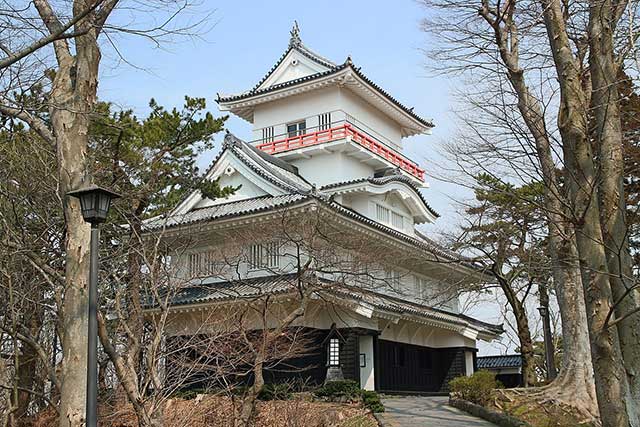
The founder of the castle is considered to be Satake Yoshinobu (1570–1633). Yoshinobu was one of the six great generals of Toyotomi Hideyoshi. During the Odawara Campaign of 1590, he took part in the siege of Oshi Castle under the command of Ishida Mitsunari, with whom Yoshinobu developed a good relationship.
-
Kavanhoe Castle
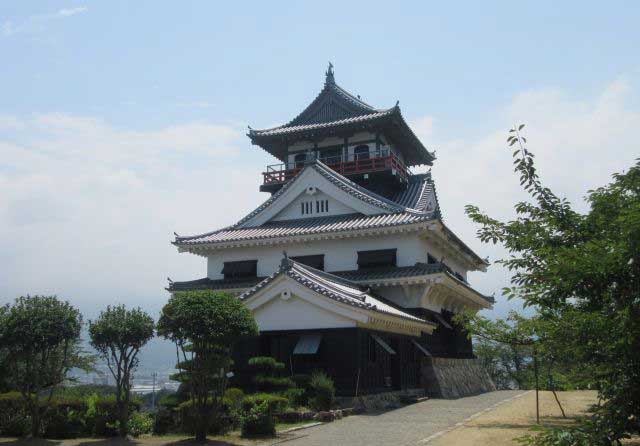
Kawanoe Castle is located on the small Wasi-yama hill near the port area of the Kawanoe district in the city of Shikokuchuo, occupying a central position along the northern coast of Shikoku Island. Kawanoe was also known as Butsuden Castle. The term “butsuden” in Japan refers to temple halls, and for this reason it is believed that a Buddhist temple once stood on the site before the castle was built. Due to its location at the junction of four provinces on Shikoku Island, Kawanoe held significant strategic importance and was repeatedly targeted by rival forces seeking military control over the region.