

A new historical exhibition in Japan tells the remarkable story of a teenage samurai who crossed the Pacific Ocean aboard the Kanrin Maru at just sixteen years old. His surviving travel writings offer a rare opportunity to experience America in 1860 through the eyes of a young Japanese traveler who witnessed one of the most important diplomatic journeys of his time.
On November 7, 2026, the Mibu Town History and Folklore Museum in present-day Tochigi Prefecture, Japan, opened a special exhibition titled The Samurai from Mibu Who Crossed the Ocean: From Perry's Arrival to the Kanrin Maru's Voyage to America.
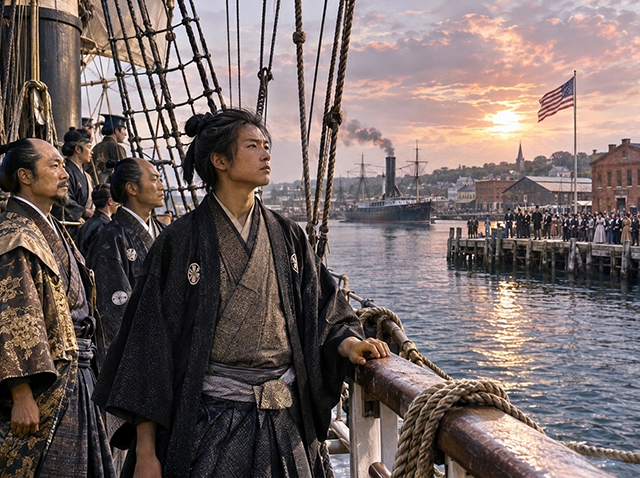
The exhibition focuses on Saito Tomezo (1844–1917), also known as Morita Tomezo. In 1860, this sixteen-year-old member of Japan's samurai class traveled to the United States aboard the Japanese warship Kanrin Maru.
Unlike famous military commanders whose names survived through their victories on the battlefield, Tomezo became part of history through a journey that introduced him to an entirely different world.
Japan on the Brink of Change
In the mid-nineteenth century, Japan was experiencing one of the most turbulent periods in its history.
For more than two centuries, the Tokugawa shogunate had tightly restricted the country's international contacts. However, advances in Western navigation and growing pressure from foreign powers were gradually forcing Japanese authorities to reconsider their policies.
In 1853, an American naval squadron commanded by Commodore Matthew Perry arrived off the Japanese coast. The encounter became a major turning point in Japan's expanding diplomatic and commercial relations with the outside world.
In 1858, Japan and the United States signed the Treaty of Amity and Commerce. Two years later, the shogunate sent an official diplomatic mission to America to exchange the treaty's instruments of ratification.
The principal delegation, which included several senior Japanese officials, traveled aboard the American warship USS Powhatan.
To accompany the mission and gain practical experience in ocean navigation, Japan dispatched its own warship, Kanrin Maru.
Among the men aboard was sixteen-year-old Saito Tomezo.
Who Was This Young Samurai?
Tomezo was born in 1844 into a samurai family in the Mibu Domain. The fourth son of the family, he received an education that exposed him to subjects beyond traditional warrior training.
In 1855, he entered a school associated with Egawa Tarozaemon, where he studied Western artillery and rangaku, or Dutch learning—the body of European knowledge that reached Japan largely through Dutch-language sources.
His abilities attracted attention, and he subsequently became a trainee associated with the Nirayama administrative office.
When preparations began for the transpacific expedition, the young samurai was selected to take part.
According to the Mibu museum's official announcement, Tomezo sailed as an attendant to the naval official Kimura Yoshitake, also known by his title Kimura Settsu-no-kami.
Local biographical records additionally describe him as the ship's drummer and its youngest crew member.
For a teenager raised in a provincial Japanese domain, the journey meant traveling to a country that most of his contemporaries knew only through books and secondhand accounts.
Thirty-Seven Days Across the Pacific
Kanrin Maru was an unusual vessel for the Japanese navy of its time.
Built in the Netherlands and launched in 1857, it was a wooden, three-masted ship equipped with both sails and an auxiliary steam engine.
The vessel measured approximately 162 feet (49.5 meters) in length, carried twelve guns, and could rely on both wind and steam power.
During the 1860 expedition, its crew included Japanese sailors, naval officials, and American specialists.
Among those traveling aboard were Katsu Kaishu, the future Japanese intellectual and educator Fukuzawa Yukichi, and American naval officer John Mercer Brooke.
The Pacific crossing took 37 days and became an important test for Japan's developing navy, which was still learning the techniques of modern ocean navigation.
On March 17, 1860, Kanrin Maru arrived in San Francisco.
For Saito Tomezo, crossing the ocean was only the beginning. He was about to encounter an American society whose customs, technology, and everyday life differed dramatically from the Japan he had known during the Edo period.
America Through the Eyes of a Sixteen-Year-Old
The most valuable part of the new exhibition is Tomezo's surviving written account.
The museum is displaying his travel writings, titled 亜行新書, documenting his experiences during the journey to America.
According to the exhibition's organizers, the young samurai recorded his impressions of unfamiliar landscapes, customs, and people.
What makes the material particularly compelling is the author's age. Tomezo was neither the head of a diplomatic mission nor a senior official required to report on negotiations.
His observations offer a more personal perspective on the journey—one shaped by a young person's first encounters with a foreign culture.
The museum emphasizes the vividness and spontaneity of his descriptions.
However, the publicly available exhibition announcement does not provide a complete transcription of the manuscript. Individual statements or impressions should therefore not be presented as direct quotations without consulting the original document.
Photographs That Preserved a Remarkable Journey
The exhibition also includes Tomezo's personal photograph album.
Its contents feature images of the traveler himself alongside photographs of prominent Japanese political figures from the transition between the Tokugawa shogunate and the Meiji period.
One particularly noteworthy item is a portrait later presented to Tomezo by Fukuzawa Yukichi, another Kanrin Maru passenger who became one of nineteenth-century Japan's most influential intellectuals.
The exhibition also displays historical materials associated with other members of the expedition, including an illustrated work connected to Katsu Kaishu and a celestial globe used by navigator Ono Tomogoro.
Together, these objects reveal the voyage as more than a diplomatic event. It was also a technical, scientific, and deeply human achievement.
What Happened to Tomezo After His Return?
The 1860 expedition was not Tomezo's only journey to America.
After returning to Japan, he was adopted by Morita Sadakichi, who was associated with the Egawa family. This explains why historical records refer to the young samurai by both the Saito and Morita surnames.
In 1871, Tomezo returned to the United States as a student accompanying the Iwakura Mission, an important diplomatic expedition organized by Japan's new Meiji government. He continued studying military subjects during his time in America.
In 1875, he traveled to the United States again, this time at his own expense, to study agriculture.
According to Mibu's local historical archive, Tomezo attempted to establish one of Japan's earliest modern sheep-farming operations in 1880.
His life reflects the extraordinary transformation of nineteenth-century Japan. A young man raised in the samurai class became involved in the modernization of a country increasingly eager to adopt foreign scientific and practical knowledge.
Why Does This Story Matter Today?
The history of nineteenth-century relations between Japan and the United States is often told through diplomats, political leaders, and naval officers.
Yet many people who participated in these historic journeys had little influence over major political decisions.
Saito Tomezo was one of them.
His surviving writings remind us that Japan's encounter with the wider world was not merely a diplomatic process. It also consisted of personal experiences, unexpected discoveries, curiosity, and efforts to understand unfamiliar cultures.
The new exhibition in Mibu invites visitors to rediscover these records and explore an important chapter of Japanese-American history through the life of a sixteen-year-old samurai.
The exhibition The Samurai from Mibu Who Crossed the Ocean runs from November 7 through December 20, 2026. Admission is free.