

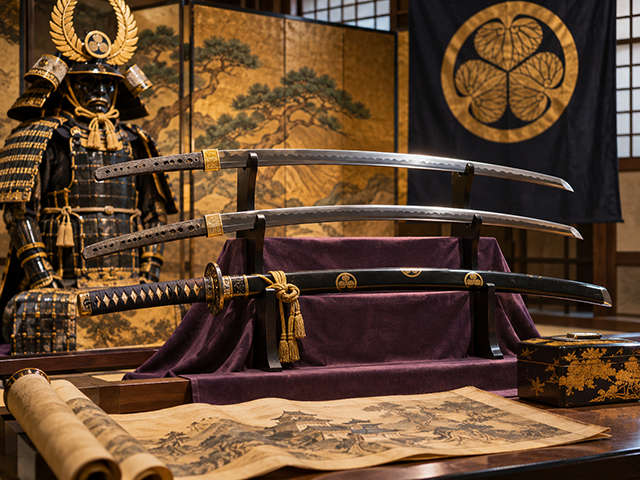
In November 2026, the Shizuoka City Museum of History turned its attention to a fascinating aspect of Tokugawa Ieyasu's life: his personal swords. The founder of the shogunate that ruled Japan for more than two and a half centuries left behind not only a political legacy but also historic weapons, some of which survive today.
On November 8, the museum scheduled a special lecture examining Ieyasu's swords, focusing on blades preserved at Kunozan Toshogu Shrine, where important objects associated with the first Tokugawa shogun are kept.
From Warlord to Ruler of Japan
Tokugawa Ieyasu (1543–1616) lived through an age of almost continuous warfare, when powerful Japanese warlords competed for territory, influence, and control of the country.
He participated in major military and political events of the Sengoku period, Japan's era of warring states. Following the Eastern Army's victory at the Battle of Sekigahara in 1600, Ieyasu consolidated his position and received the title of shogun in 1603.
The political system he established survived until 1867.
For Ieyasu, a sword was more than a weapon. In samurai society, swords could symbolize military rank, family heritage, and political authority. Particularly valuable blades passed from generation to generation, were exchanged as prestigious gifts, and were preserved as treasured heirlooms.
Sohaya no Tsurugi: One of Ieyasu's Most Famous Swords
Among the surviving blades, Sohaya no Tsurugi occupies a special place. The Kunozan Toshogu Museum identifies it as one of Ieyasu's cherished swords.
It is a tachi, a long Japanese sword traditionally suspended from the waist with its cutting edge facing downward. Unlike the later custom of wearing a katana with its edge facing upward, the tachi is particularly associated with earlier Japanese warrior traditions.
The surviving blade bears no maker's signature, but its manufacture is attributed to the swordsmith Mitsuyo. According to the museum, it dates approximately to the middle of the Kamakura period (1185–1333).
The sword is distinguished by its broad blade and imposing proportions. Today, Sohaya no Tsurugi is designated an Important Cultural Property of Japan.
The shrine preserves the sword as one of its most significant relics associated with Ieyasu. During the Edo period, it received a level of reverence comparable to that accorded to sacred objects.
More Than Long Swords
The collection at Kunozan Toshogu demonstrates that Ieyasu's surviving weapons were not limited to a single celebrated blade.
Earlier museum exhibitions also featured two wakizashi, or short swords, attributed to the swordsmiths Yukimitsu and Sadamune. Both are designated Important Cultural Properties.
A wakizashi was a shorter Japanese sword that, in later samurai tradition, was commonly worn alongside a katana. This pairing was known as daisho, literally meaning "large and small."
Of particular interest is the way some of Ieyasu's swords were preserved. Museum records describe blades kept in specially decorated storage cases within sacred areas of the shrine complex.
Their preservation illustrates how objects originally made for warfare could acquire historical and religious significance.
Why Have Ieyasu's Swords Survived?
After Ieyasu's death in 1616, his memory became deeply embedded in the political and religious culture of the Tokugawa shogunate.
Kunozan Toshogu Shrine, located on Mount Kuno in present-day Shizuoka Prefecture, became one of the principal places dedicated to honoring the former ruler.
His personal possessions, weapons, and other belongings were preserved there, while subsequent shoguns donated additional treasures.
For example, Tokugawa Hidetada, the second shogun, donated a sword made by the smith Sanetsune in 1617. Tokugawa Iemitsu, the third shogun, presented a sword attributed to Unji in 1634.
The shrine's collection therefore reflects not only Ieyasu's personal possessions but also the history of successive generations of the ruling Tokugawa family.
What Was the November 2026 Lecture About?
The lecture, titled Tokugawa Ieyasu and Swords, was scheduled for November 8 at the Shizuoka City Museum of History.
It was presented by Yuki Miyagishima, a curator at the Kunozan Toshogu Museum. According to the official announcement, the presentation focused on the characteristics of swords associated with Ieyasu, particularly those preserved at the shrine.
The lecture formed part of a broader museum program.
From October 10 through November 29, 2026, the museum is hosting Tokugawa Ieyasu and the Toyotomi Government, an exhibition examining Ieyasu's political position under Toyotomi Hideyoshi.
Among the exhibits is a tachi made by Nagamitsu of the Bizen Osafune school. According to historical tradition, Hideyoshi presented the sword to Ieyasu, who later donated it to Shizuoka Sengen Shrine.
The official lecture announcement does not include a complete transcript. Consequently, it is not possible to establish precisely which swords were discussed or to claim that new research findings were announced during the presentation.
What Do These Swords Reveal About Ieyasu?
The surviving weapons offer a perspective on the founder of the Tokugawa shogunate beyond his achievements as a general and statesman.
They illuminate the material culture of Japan's samurai elite, including appreciation for skilled swordsmiths, the diplomatic exchange of prestigious weapons, and the preservation of family treasures.
However, ownership should not be confused with documented battlefield use. The fact that a sword belonged to a historical ruler does not establish that he carried it into a particular battle.
This distinction makes museum collections especially valuable. Careful study helps separate documented history from the legends surrounding famous samurai.
More than four centuries after Tokugawa Ieyasu's death, his surviving swords remain tangible reminders of an era when Japanese blades could simultaneously represent military power, political authority, and sacred heritage.
See also
-
Sojutsu - The Art of the Spear
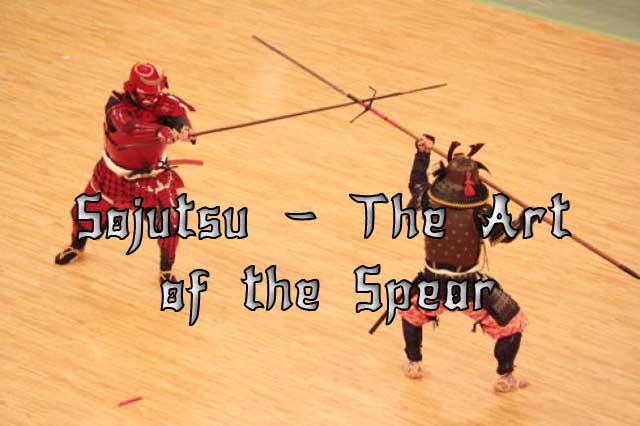
Sojutsu is a traditional Japanese martial art dedicated to the mastery of the yari spear. It is considered the second most important martial art of medieval Japan after swordsmanship.
-
Yari
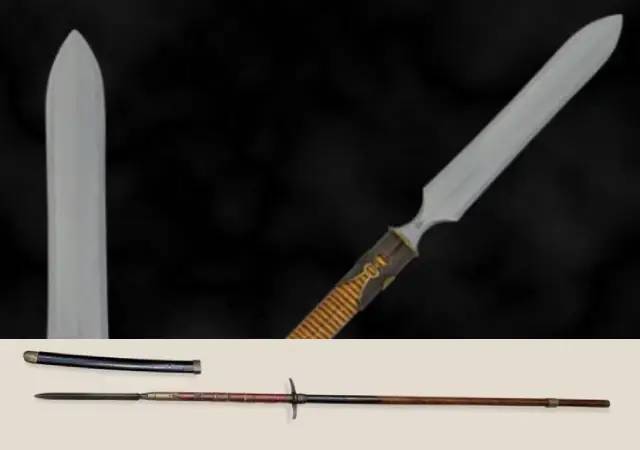
Yari is one of the traditional Japanese cold weapons (nihonto), which is a spear with a straight tip. The art of wielding a yari is known as sojutsu, a spear fighting technique.
-
Wakizashi and tanto

In the history of Japanese edged weapons there are objects that border between the concepts of “sword” and “knife”. This is especially true of the wakizashi, a short sword traditionally carried by samurai along with the katana, and the tanto, a combat knife popular among a wide range of social classes. Both items were worn behind the belt, had a short blade, and were used in close combat. However, there is a fundamental difference between the two, and it goes far beyond simple blade length.
-
Katana and Tachi
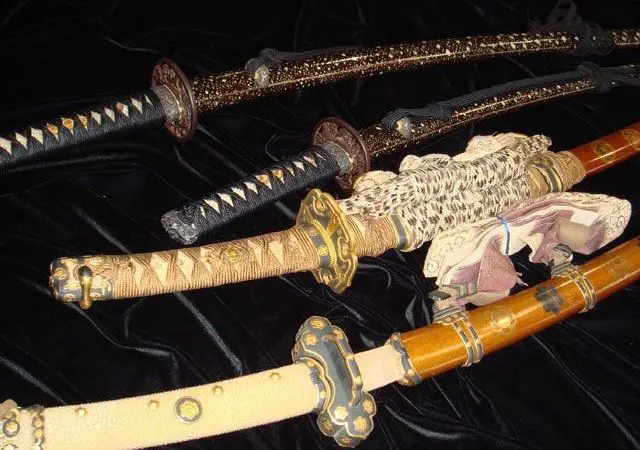
When Westerners think of Japanese swords, they often picture the iconic curved blades like the katana. However, in terms of historical precedence and prestige, it would be more accurate to reverse this image—the tachi predates the katana and traditionally held a higher status.
-
Daisho: The Origins and Evolution of the Samurai Sword Pair
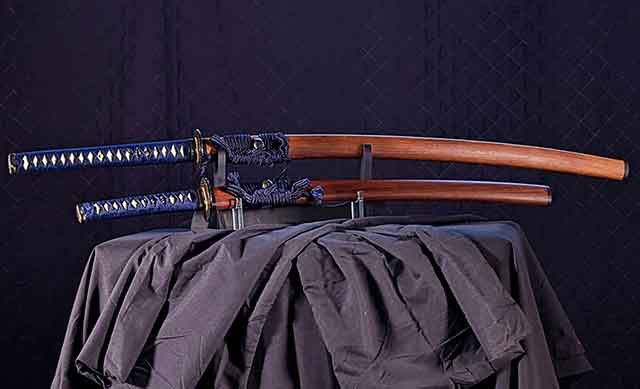
The term "daisho" finds its roots in the combination of two Japanese words: "daito," denoting a long sword, and "shoto," signifying a short sword. The combination of the words daito and shoto made the word. Daisho referred to the practice of wearing both a long and short katana together, regardless of their matching characteristics. While the classic depiction of daisho involves a katana and wakizashi (or tanto) in matching koshirae, any pairing of a longer sword with a tanto can also be considered a daisho. It later came to mean two swords with coordinated fittings. While having blades from the same swordsmith was an option, it was not a requirement for a pair to be classified as a daisho, as this would have been a more costly choice for a samurai.
-
Tanto
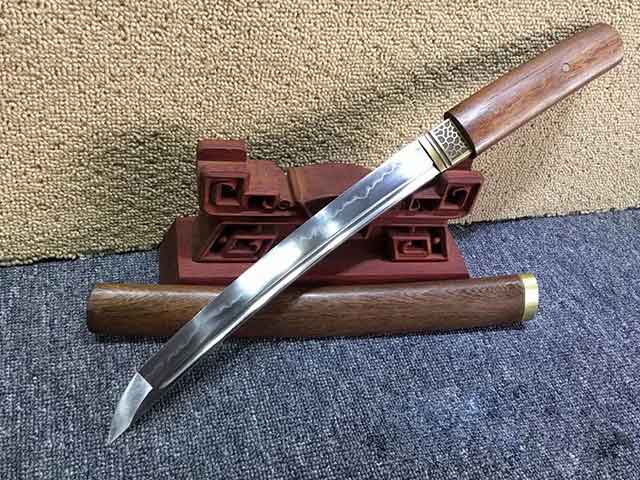
The Tanto knife is a traditional Japanese dagger that was once an integral part of the samurai warrior’s arsenal. It is known for its unique shape and cutting ability, and it is still revered by many martial artists and knife enthusiasts today.
-
Tachi
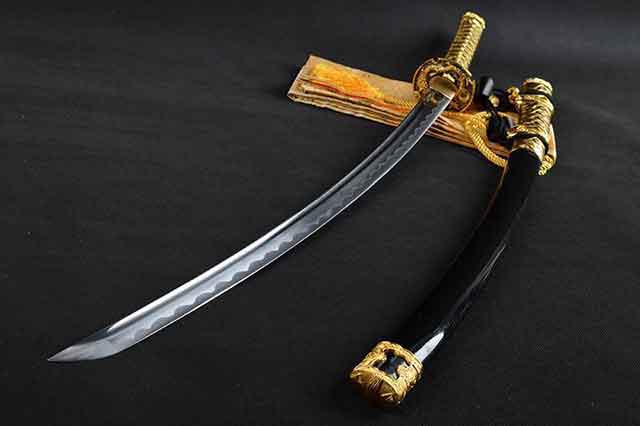
The samurai sword known as Tachi is one of the most iconic weapons in Japanese history. Its unique design and construction made it a popular choice among samurai warriors, and it played a significant role in many battles throughout Japan's history.
-
Nagitana
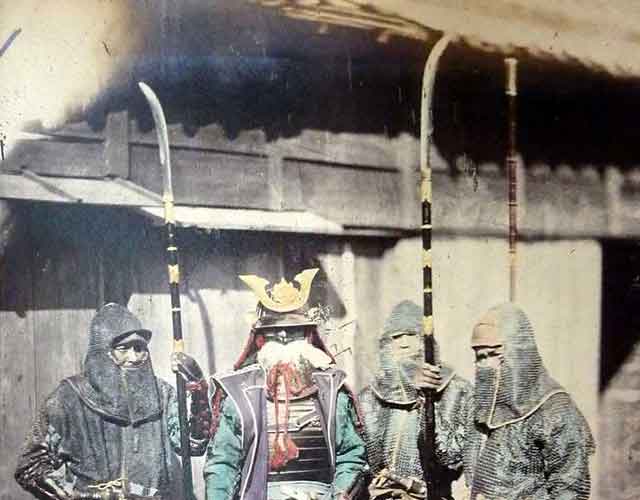
The Nagitana is a formidable weapon that was used by the samurai during feudal Japan. It was a polearm that combined the elements of a spear and a sword, making it a versatile weapon that was effective both at long range and in close combat. In this article, we will explore the history, construction, characteristics, and usage of the Nagitana.